Adapting to Google AI: Local SEO Strategies
Google AI, Local SEO, Digital Marketing, Lead Generation, Small Business Strategy, Content Marketing
Will Google AI Overviews Replace Local SEO?
If you run a local or service-based business, Google’s AI Overviews can feel like the rug is being pulled from under traditional local SEO. But for small and medium businesses focused on lead generation, the real question isn’t “Will AI kill local SEO?”—it’s “How do we adapt so AI Overviews work for us, not against us?”
Turning Google AI Overviews Into Local Advantage
How small businesses can protect and grow local visibility
Direct answer: No, AI Overviews won’t replace local SEO – they’ll raise the bar
Google’s AI Overviews, now powered by Gemini 3.5 Flash and embedded into the Intelligent Search Box, are changing how answers appear—especially for local and service queries. But they still depend on the same foundations: accurate local data, strong entities, trusted content, and consistent signals across the web. Local SEO isn’t going away; it’s becoming the data layer that AI Overviews read from.
Executive Perspective: Why Google AI Overviews Matter More Than Most Businesses Realize
Google AI Overviews represent one of the biggest shifts in search since the introduction of mobile-first indexing. For years, businesses competed primarily for rankings and clicks. Today, they increasingly compete for inclusion within AI-generated answers. This changes how visibility is earned. Instead of optimizing solely for search engines, businesses must optimize for systems that evaluate trust, authority, accuracy, and relevance before deciding which sources to reference. Organizations that understand this shift early will gain disproportionate visibility as AI-generated search experiences continue expanding.
Key insights for SMB owners and marketing leaders
Zero-click is the new normal: AI Overviews and zero-click results already account for more than half of searches, so you must optimize for visibility and leads, not just clicks.
GEO + AEO are the new local SEO multipliers: Generative Engine Optimization (GEO) and Answer Engine Optimization (AEO) are about being cited and summarized by AI, not just ranking blue links.
Brand and entity strength win: Google’s AI leans heavily on trusted entities, consistent NAP data, reviews, and expert content when composing overviews.
From classic local SEO to GEO & AEO: what actually changes
Traditional local SEO focused on ranking your Google Business Profile, map pack visibility, and localized landing pages. In the AI era, you still need those, but you must also structure your content so Google’s models can safely quote and synthesize it.
AEO (Answer Engine Optimization): Build clear, conversational answers to real questions (“best plumber near me for emergencies”) using FAQ blocks, headings, and schema markup so you’re a candidate source when AI Overviews fire.
GEO (Generative Engine Optimization): Create authoritative, interlinked content clusters around your services and city so generative systems see you as a topic authority, not just a listing.
The Emergence of Entity-Based Local Search
One of the most important changes introduced by AI Overviews is the growing importance of entities. Search engines are becoming less focused on individual pages and more focused on understanding businesses as complete entities. Reviews, citations, social profiles, service pages, Google Business Profiles, and customer interactions all contribute to a business's digital identity. The stronger and more consistent that identity becomes, the easier it is for AI systems to confidently recommend and reference the business within local search experiences.
If you want help architecting that ecosystem, a digital consultancy engagement can align your local SEO, GEO, and lead generation into a single roadmap.
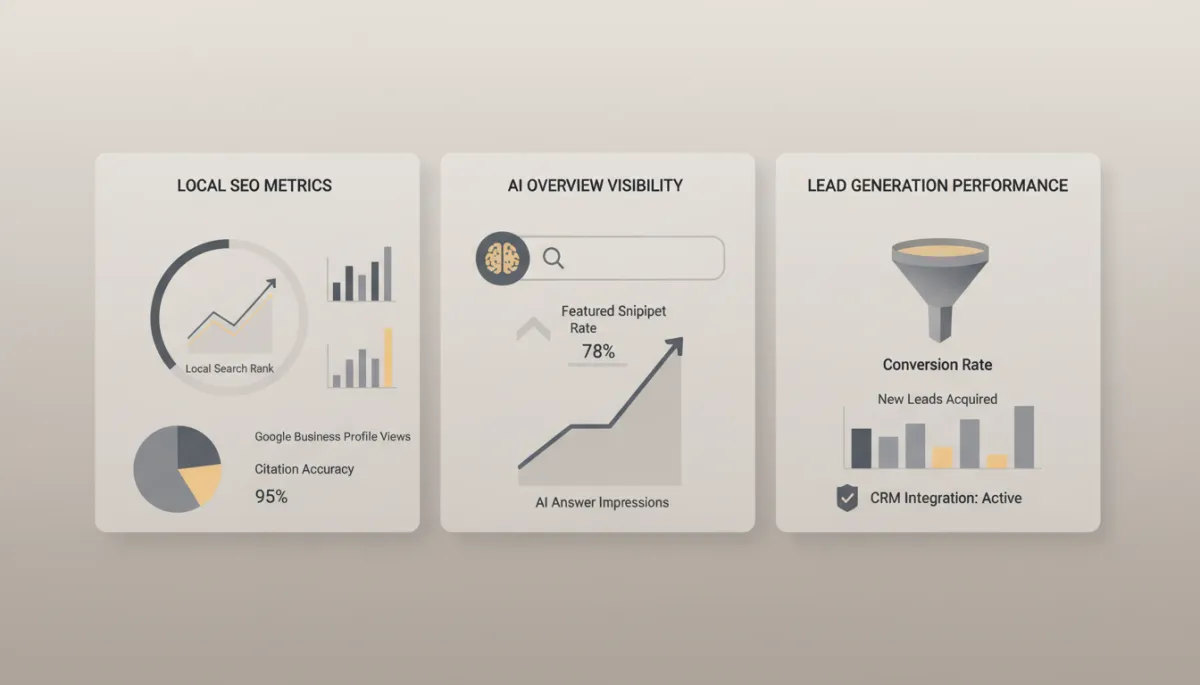
Real-world pattern: who wins in AI Overviews
Across local campaigns, we see the same pattern: businesses with deep, structured content and clean local signals continue to show up in AI-powered results, even as pure “10 blue links” SEO loses ground.
Content depth: A documented content marketing strategy that covers FAQs, comparisons, pricing, and local use cases is far more likely to be surfaced and summarized by Gemini-based search.
Multi-surface presence: Active social profiles, supported by professional social media marketing, strengthen the brand signals AI uses to gauge trust.
Conversion systems: When AI Overviews reduce clicks, every visit must convert better. Tools like MagnoPro and GoHighLevel help turn fewer visits into more booked calls.
Why Some Businesses Are Disappearing From Search
Many local businesses continue publishing content using outdated SEO tactics that focus heavily on keyword repetition and content volume. AI systems increasingly reward expertise, clarity, and usefulness instead. Businesses that publish shallow or generic content often find themselves excluded from AI-generated summaries because their information does not add enough value to justify inclusion. This creates a widening gap between businesses that build authority and those that simply produce content.
Executive Diagnostic: Is Your Business Ready for AI Search?
Business owners should ask themselves several important questions. Does our content directly answer customer questions? Are our reviews detailed and consistently updated? Is our Google Business Profile actively maintained? Can AI systems clearly understand our services, locations, and expertise? Do we have systems that convert traffic into conversations and appointments? If the answer to several of these questions is no, then improving operational readiness may produce better results than publishing more content.
AEO & GEO checklist for local lead generation
Clarify your local entity: Consistent NAP, categories, and service area; invest in reviews and local citations. Systems like the Local Visibility Operating System help keep this tight.
Build answer-first content: Use structured FAQs and short, direct paragraphs that mirror how people ask questions in voice and AI search.
Connect content and CRM: Route AI-driven traffic into automated follow-up. A GoHighLevel trial or MagnoPro demo is often the fastest way to operationalize this.
Plan campaigns, not posts: Use a dedicated content strategy framework or schedule a marketing strategy session to align topics with revenue goals.
The Competitive Advantage of Early Adoption
Many businesses still treat AI search as a future concern rather than a current opportunity. This creates a significant advantage for organizations willing to adapt now. Businesses that build structured content, strengthen local entities, improve review acquisition, and implement AI-ready marketing systems today are effectively building a moat around their market position. As AI-generated search continues to expand, the gap between early and late adopters is likely to widen substantially.
Contrarian view: stop obsessing over traffic, start owning demand
Most local businesses are still asking, “How do we get our traffic back?” That’s the wrong question in a world where AI Overviews, search agents, and even Gemini-powered hardware answer queries without a click. The better question is: How do we become the brand that AI keeps recommending?
That means shifting focus from raw sessions to qualified conversations. Platforms like GoHighLevel, with its annual plan, SaaS upgrade, and AI features, help you capture, nurture, and close leads even as surface-level traffic fluctuates.
The New Visibility Equation
In traditional SEO, visibility was largely driven by rankings. In AI-driven search, visibility is increasingly determined by authority, trust, and relevance. Businesses should begin measuring success through metrics such as branded search growth, review quality, booked appointments, direction requests, and lead volume rather than focusing exclusively on organic traffic. These indicators better reflect how AI-powered discovery influences real-world business outcomes.
Measuring Success in an AI-Driven Search Environment
Traditional SEO reporting focused heavily on rankings, clicks, and traffic volume. While these metrics remain useful, they no longer tell the full story. Businesses should begin tracking branded search growth, Google Business Profile interactions, review acquisition rates, direction requests, call volume, booked appointments, and lead quality. These indicators provide a more accurate picture of how AI-powered discovery is influencing revenue and customer acquisition.
Local Search Maturity Framework
Businesses generally progress through four stages. The first stage is Presence, where listings and basic local information exist. The second is Optimization, where reviews, local pages, and structured data are implemented. The third is Authority, where content, expertise, and reputation create differentiation. The fourth is Recommendation, in which AI systems consistently present the business as the preferred solution. The ultimate goal of modern local SEO is no longer simply ranking—it is becoming the recommended answer.
FAQs: Google AI Overviews & local SEO
1. Do I still need a Google Business Profile?
Yes. It remains the core local entity signal that AI Overviews and map results rely on. Optimize categories, services, photos, and reviews before chasing advanced GEO tactics.2. How do I know if AI Overviews are hurting my traffic?
Watch branded and high-intent non-branded queries in Search Console. If impressions stay flat but clicks drop while leads are stable, AI is answering more upfront—you need stronger conversion systems, not panic.3. What content works best for AI Overviews?
Clear, specific, locally grounded answers: pricing ranges, service comparisons, step-by-step explanations, and safety or compliance details. This is where a structured content marketing plan pays off.4. Is schema markup still worth it?
Yes. Structured data helps Google’s models understand your services, locations, FAQs, and reviews, increasing your odds of being cited in AI-generated answers.5. Should I invest more in social or search?
In 2026, it’s not either/or. Social discovery feeds brand demand; search and AI Overviews harvest it. A balanced plan, often supported by strategic social campaigns, works best.6. How can my team keep up with all these changes?
Short, focused enablement helps. Consider HighLevel Bootcamp or upgrading to done-with-you support so your systems evolve with Google AI.
Future Outlook: Search Becomes a Recommendation Economy
As AI continues to evolve, search engines will increasingly function as recommendation engines rather than information retrieval systems. Users will receive fewer lists of options and more direct recommendations based on context, intent, location, and trust signals. Businesses that invest today in authority, reputation, structured data, and customer experience will be positioned to benefit as recommendation-driven discovery becomes the dominant search model.
The AI Visibility Framework
The businesses most likely to dominate local search over the next decade will consistently execute five interconnected activities: maintaining accurate business data, generating authentic customer reviews, publishing helpful answer-focused content, implementing structured data, and connecting visibility efforts directly to lead-generation systems. When these elements work together, businesses create a self-reinforcing visibility engine that strengthens both traditional search performance and AI recommendation potential.
Strategic takeaway: local SEO becomes your AI-ready operating system
Google AI Overviews are not eliminating local SEO—they are transforming it into a broader ecosystem of visibility and trust. Businesses that invest in authority, reputation, structured content, customer experience, and conversion infrastructure will be positioned to benefit from every evolution in search technology. The future belongs to organizations that become the most reliable answer, the most trusted recommendation, and the easiest business for both customers and AI systems to understand. As search becomes increasingly AI-driven, local SEO will evolve from a marketing tactic into a core business asset that directly influences growth, lead generation, and market leadership.


