
AI's Impact on Local SEO for Business Growth
Local SEO, AI, Lead Generation, Small Business Marketing
How AI Is Rewriting the Rules of Local SEO for Growth-Focused Businesses
Local SEO is no longer about “ranking for plumbers near me.” In 2026, AI-driven search, answer engines, and geo-personalization are deciding which businesses get discovered, trusted, and contacted first — often without a single website click.
Direct Answer: How Is AI Changing Local SEO?
AI is shifting local SEO from keyword-based rankings to entity-based, trust-driven visibility, where accurate data, real engagement, and review signals determine whether your business is surfaced in AI Overviews, maps, and answer engines. In one sentence: local SEO success now depends less on “tricks” and more on being the most trusted, structured, and contextually relevant local answer.
Key Insights for SMB Owners and Lead-Gen Marketers
AI Overviews and answer engines compress the funnel — more “zero-click” searches, but higher-intent direction and call actions.
Google Business Profile (GBP) has become a live data hub, not a static listing; posting, Q&A, and reviews are core ranking signals.
Answer Engine Optimization (AEO) and Geo-Entity Optimization (GEO) are now mandatory disciplines for serious lead generation.
Why This Shift Matters Commercially
Industry data shows AI Overviews now appear on a large share of local queries, and studies report that AI-crawled, structured sites can generate up to 320% more human traffic and higher conversions than non-optimized peers. At the same time, Trustpilot’s analysis indicates that businesses with 80+ detailed reviews are featured in more than 75% of AI-generated answers, while those with no reviews are almost invisible. For small and medium businesses, this is not a theoretical shift — it directly affects phone calls, direction requests, and booked appointments.
This is exactly where strategic partners and systems matter. A structured digital consultancy approach, paired with tools like MagnoPro and HighLevel, allows agencies and growth-focused SMBs to turn AI-driven local search into a predictable lead engine instead of a black box.
Core Strategies: From Keywords to Entities, from Pages to Systems
1. AEO: Answer Engine Optimization for Local Queries
AEO means designing your content so AI systems can confidently quote you as the best answer. For local SEO, that includes:
Structuring service pages with FAQ, How-to, and LocalBusiness schema so AI can extract precise, geo-specific answers.
Writing conversational, intent-led content that matches voice queries (“Who is the best roofer open now in [neighborhood]?”).
Publishing topical content that demonstrates expertise — for example, a structured content marketing strategy focused on local problems, not generic tips.
2. GEO: Geo-Entity Optimization and Real-World Signals
GEO is about making your business the most trustworthy local entity in your category. Practically, that means:
Absolute consistency of NAP (name, address, phone) and categories across GBP, directories, and your website.
Frequent GBP posts (at least twice weekly), accurate hours, and active Q&A — AI reads these as “freshness and reliability.”
Systematic review generation and responses, automated via platforms like Local Visibility Operating System and HighLevel AI.
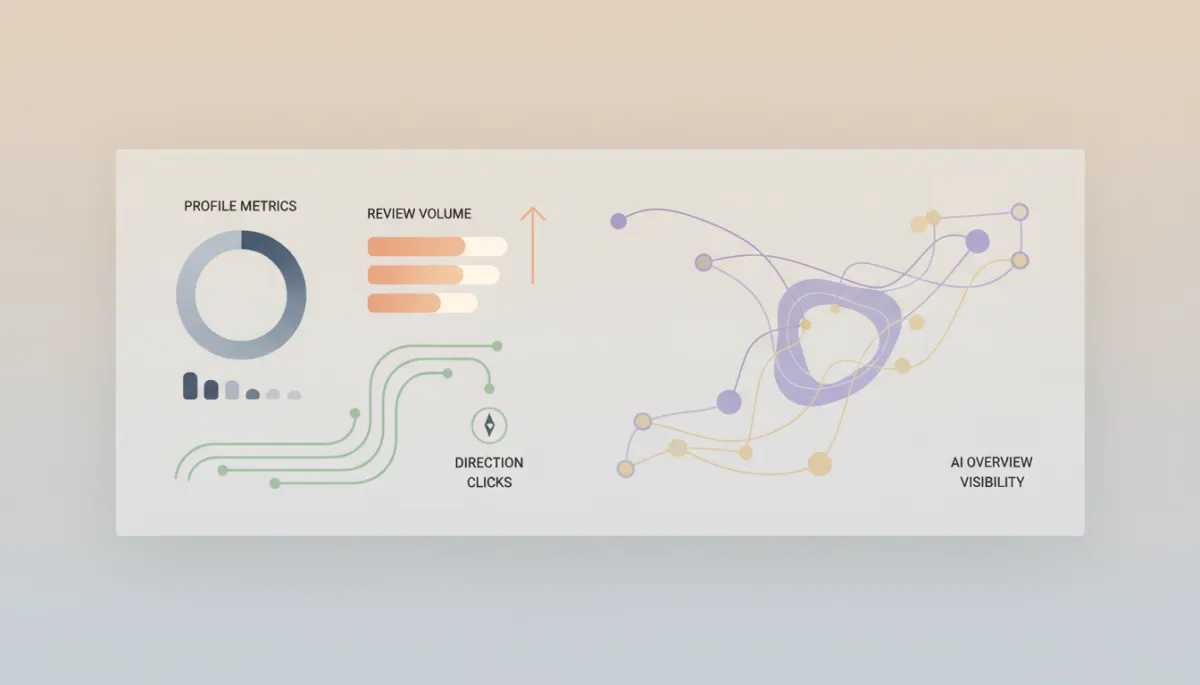
Direction clicks and review volume now correlate more closely with revenue than raw website traffic.
Execution: Systems, Operations, and Measurement
For agencies and in-house teams, the opportunity is to operationalize AI-aware local SEO rather than treat it as a campaign. Tools like MagnoPro and HighLevel annual plans allow you to:
Automate citation checks, review requests, and social proof distribution across channels, supported by social media management.
Centralize call tracking, form fills, and direction clicks to attribute revenue, not just traffic, to local SEO.
Deploy AI assistants to respond to reviews and FAQs at scale while maintaining brand voice.
For more advanced teams, HighLevel SaaS and $297 upgrades let you productize this stack for clients, combining local SEO, CRM, and AI workflows into a recurring-revenue service.
Real-World Examples and a Contrarian View
A multi-location home services brand using an AI-driven local visibility system saw website clicks plateau, yet store visits and bookings rose after focusing on reviews, GBP posts, and structured FAQs. Direction requests became the key leading indicator — aligning with reports that AI Overviews push users to act directly from the SERP rather than browse multiple sites.
A contrarian but important insight: chasing more content isn’t the answer. Many businesses are publishing AI-generated blogs at volume, but without entity clarity, review depth, or verified data, they simply feed the models without earning visibility. In 2026, fewer, better-structured assets — combined with a clear marketing strategy session and focused content strategy — outperform bloated content libraries.
Governance, Risk, and Future Thinking
With AI synthesizing information from multiple sources, inaccurate data or aggressive “review gating” can backfire quickly. Governance now means:
Regular audits of GBP, schema, and citations for inconsistencies that could confuse AI systems.
Clear policies for AI-generated content and automated review responses to avoid reputational risk.
Training teams via resources like HighLevel Bootcamp and pro trials to understand how AI-driven funnels differ from legacy SEO.
Final Strategic Takeaway
For small and medium business owners and marketing leaders in lead generation, the question is no longer “How do we rank number one?” but “How do we become the most trusted, structured, and verifiable local answer in our category across AI Overviews, maps, and answer engines?” The organizations that win will combine AI-aware AEO and GEO, robust review and data governance, and integrated platforms like LeadMagno and HighLevel AI into a single operating system for local visibility. Those who treat AI as a bolt-on tool — or cling to keyword-era thinking — will increasingly compete for the leftovers.


