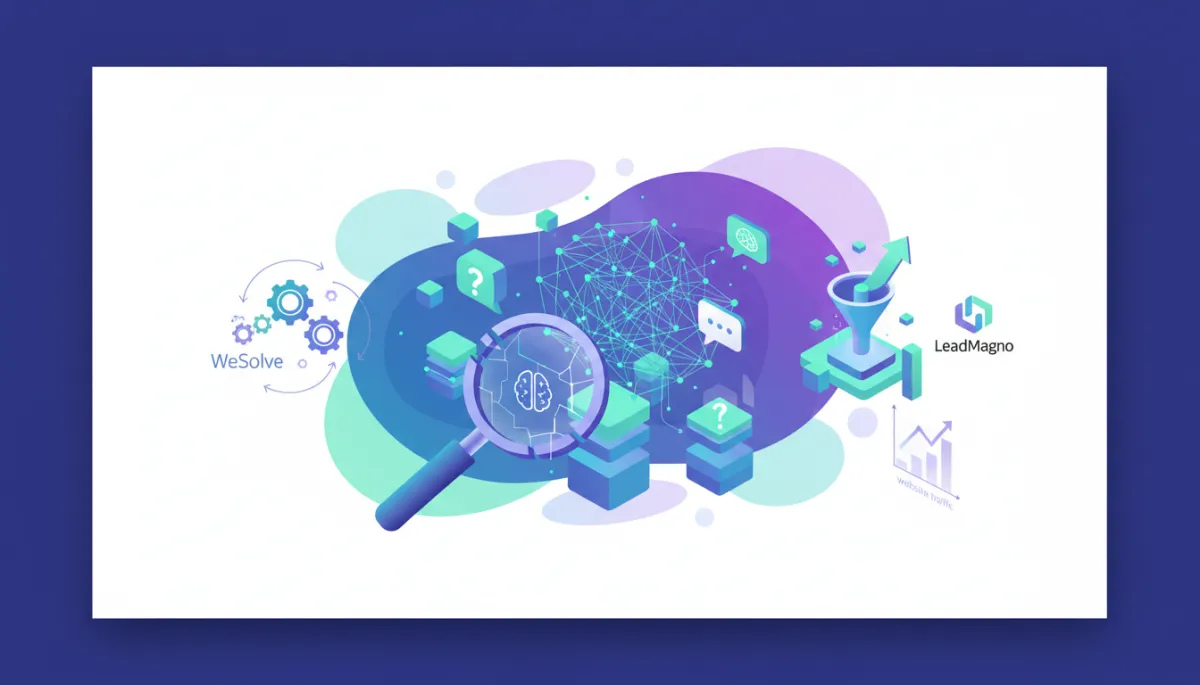
AI Search Shift: Rethink Keyword Rankings
AI Search, AEO, GEO, Digital Strategy
AI Search Is Expanding Digital Visibility Beyond the Blue Links
AI search is quietly rewriting the rules of digital visibility. Rankings and traffic still matter, but they no longer tell the full story of where and how your brand appears across search results, AI-generated answers, and assisted research journeys.
Direct Answer
Traditional keyword rankings remain important, but they now represent only one part of search visibility. AI-powered features—such as AI Overviews, AI Mode, and conversational tools like ChatGPT and Perplexity—can surface your brand inside generated answers, summaries, and recommendations even when a classic blue-link click does not occur. To understand your true visibility, evaluate rankings, impressions, AI-assisted exposure, identifiable referrals, and the quality of resulting leads together.
Quick Summary
AI search is expanding—not replacing—traditional SEO. Google states that established SEO practices still apply to AI Overviews and AI Mode, and no separate technical playbook is required solely to appear in these features. A brand can now be discovered through blue links, knowledge panels, local results, and AI-generated answers. Modern strategies combine SEO, Answer Engine Optimization (AEO), and Generative Engine Optimization (GEO) to strengthen visibility, trust, and conversions across this broader landscape. For more detail, see Google’s guidance for AI features and websites.
1. The AI Search Shift: From Blue Links to Answers and Agents
Search is no longer limited to a traditional list of links. Search increasingly includes generated answers, supporting sources, follow-up questions, and agent-assisted actions alongside traditional results. AI-powered platforms and search features such as ChatGPT, Gemini, Perplexity, Claude, Google AI Overviews, and AI Mode can interpret intent, retrieve information from multiple sources, and generate synthesized responses. Google has confirmed that Gemini 3.5 Flash is the global default model in AI Mode and that information agents can operate in the background to fetch and filter information for users around the clock in Google’s official AI Search announcement.
BrightEdge, in its own vendor research, reports that AI agent queries already account for 88% of the human organic search activity it monitors, and projects that agent-driven activity could surpass human-driven search volume by the end of 2026. These are findings and projections from BrightEdge’s monitored dataset, not definitive measurements of all global search behaviour. In parallel, Google has launched generative-AI performance reporting in Search Console so brands can track AI visibility—including impressions, pages appearing in AI Overviews and AI Mode, countries, devices, and performance over time. The rollout initially covers only a subset of websites and is primarily focused on visibility and impressions, not full AI citation tracking.
2. What AI Search Visibility Really Means in 2026
AI search visibility is your brand’s ability to be cited, quoted, or used as a source inside AI-generated answers—whether in ChatGPT, Perplexity, Gemini, Copilot, or Google’s AI Overviews. It is less about “position one” and more about:
How often your brand and content are referenced by LLMs
Whether AI-search systems can retrieve, understand, and corroborate your information
How clearly your expertise is linked to specific topics, entities, and locations
With consumer behaviour shifting toward conversational queries and multi-step research, the goal is no longer simply to win one keyword. It is to become a consistently recognized and well-supported source within a defined area of expertise when AI systems synthesize answers in your niche. Importantly, this expands on—not replaces—traditional SEO: Google continues to state that established SEO practices remain relevant for content that can appear in AI Overviews and AI Mode.
3. AEO and GEO: Strategic Layers Within Modern SEO.
Two disciplines now sit at the heart of AI search visibility. They are strategic approaches rather than official Google ranking systems:
Answer Engine Optimization (AEO) focuses on making your content the best possible direct answer to specific questions. Think of it as optimizing for answer boxes, voice assistants, and AI summaries across platforms. It relies on clarity, concision, and structured context so engines can extract clean, authoritative responses.
Generative Engine Optimization (GEO) goes a step further by considering how generative models like ChatGPT or Perplexity compose longer explanations, comparisons, and recommendations. GEO aims to make a brand’s information clear, consistent, well-supported, and useful across generated explanations and comparisons.
Google describes AEO and GEO as industry terms and considers optimization for generative AI search part of the wider SEO discipline (Google for Developers).
💡 Key Insight: AEO strengthens individual answers, while GEO strengthens broader visibility across generated research journeys.
4. How LLMs See Your Brand: Structuring Digital Data for AI
AI-search platforms do not “scan your website” exactly as a human reader does. Behind the scenes, they can combine traditional web crawlers, search indexes, retrieval systems, query expansion, structured information, and large language models to interpret and assemble answers. To appear in AI answers, you must make your digital footprint legible to these systems. Three concepts matter most:
Entity trust
Your brand is an entity in the AI ecosystem—just like a person, place, or product. Entity trust grows when:
Your name, address, and details are consistent across the web
Author bios, reviews, case studies, and citations reinforce your expertise in a clear niche
Third-party sites and directories corroborate your claims
Structured data and schema markup
Structured data—schema markup for organizations, services, products, events, and reviews—acts like a translation layer between your site and AI systems. It helps engines understand who you are, what you do, and how each page fits into your broader expertise in a machine-readable way. Not every schema type produces a supported search feature, and Google deprecated the FAQ rich-result feature in May 2026 (Google for Developers). Google states that no special schema markup or separate technical optimization is required specifically for inclusion in AI Overviews or AI Mode. Structured data should accurately describe the visible page content and provide context rather than being treated as an AI-ranking shortcut (Google Search Central). Structured data should match the visible page content, but Google does not require special schema or machine-readable AI files for generative search visibility (Google for Developers).
The micro-questions strategy
Users now phrase queries as highly specific, conversational questions. Instead of one broad “SEO services” page, you need concise, well-organized answers to clusters of micro-questions such as “What is Answer Engine Optimization?”, “How do I track AI Overview visibility?”, or “How can a local consultant rank in Perplexity?” Each well-developed answer creates a clearer passage that retrieval systems may identify and surface in responses. Google has also described a “query fan-out” process, where AI Overviews and AI Mode may perform several related searches before assembling an answer, increasing the value of covering related micro-topics within strong, authoritative pages and sections rather than thin, single-question pages (Google Search Central).

Organizing related questions into clear sections helps readers and retrieval systems understand the topic.
5. From Narrative to Modular: Restructuring Content for AEO and GEO
Traditional blog posts are often written as long, flowing narratives. Well-organized, modular sections can make information easier for readers and retrieval systems to identify and reuse—especially when each section clearly addresses a specific question or concept. To adapt:
Break comprehensive guides into scannable modules with strong subheadings and concise opening answers followed by deeper explanation, evidence, examples, and practical guidance. Group related questions into authoritative topic hubs, service pages, guides, and FAQ sections rather than creating separate thin pages for every micro-question. This is where thoughtful content architecture and modular content planning can make a measurable difference. Google’s latest guidance specifically cautions against creating large numbers of pages for every possible query variation solely to influence generative-search results (Google for Developers).
Add FAQ sections targeting micro-questions, each with a concise answer of approximately 40–80 words as an editorial guideline for clarity—not as a technical ranking requirement.
Use consistent terminology so search, retrieval, and language systems can interpret your expertise more accurately.
💡 Pro Tip: Structure each section so it can be understood independently while still supporting the wider article.
6. Establishing Entity Authority and Systematically Answering Micro-Questions
To build stronger visibility across AI-assisted search journeys in your niche, you must build entity authority—a clear, reinforced signal that your brand is consistently associated with a focused cluster of expertise. Practically, that means:
Defining a focused expertise area (for example, “AI search strategy for professional services” rather than generic “digital marketing”).
Publishing a library of content that answers dozens of related micro-questions within that niche, organized into strong topic hubs, service pages, and guides, with structured data used where it adds clear context. For brands with a physical presence, this often intersects with local visibility and entity consistency across directories, maps, and review ecosystems.
Earning corroborating signals—mentions, reviews, interviews, and case studies—on external sites so search and AI systems encounter consistent, corroborating information about the business.
Platforms and partners can support this process by helping you identify the right micro-questions, map them to your services, and turn them into modular, AI-ready content assets that feed both AEO and GEO strategies.
7. The Digital Growth System Framework: Visibility, Trust, Conversion, Optimization
Building visibility across AI-assisted search is not just about content—it is about your entire Digital Growth System. A practical framework includes four pillars and should sit within an integrated digital growth strategy:
Visibility
Are you discoverable in AI answers, knowledge panels, local packs, and traditional SERPs? This is where AEO, GEO, entity optimization, and structured data work together to expand your surface area across AI and classic search.
Trust
Once prospects find you, do they believe you? Trust is built via authoritative content, social proof, consistent branding, and transparent data. In an era where AI search is evolving how people encounter sources, verifiable, well-structured information is a powerful differentiator. Google also notes that AI features may expose users to a broader and more diverse set of supporting links than classic search alone (Google Search Central).
Conversion
This is where the metrics shift. In an AI-expanded search environment, traffic volume and visitor intent may change as more questions are resolved inside AI-generated experiences. What matters is how many AI‑influenced visitors book a call, request a proposal, or start a trial. Connecting AI‑driven visits to lead capture, nurturing, and revenue helps you optimize for outcomes rather than focusing only on pageviews.
Optimization
Finally, you need feedback loops: AI performance reports, prompt‑level testing, content experiments, and conversion analytics. This is where ongoing refinement of your SEO, AEO, and GEO playbooks keeps your content, offers, and funnels aligned with what AI search engines are actually surfacing.
8. A Hypothetical Example: A Local Consulting Firm Embraces AEO
Consider a regional management consulting firm serving mid‑market manufacturers. For years, their SEO strategy centred on broad keywords such as “operations consulting firm” and “lean manufacturing consultant.” They generated decent traffic but inconsistent leads—and almost no visibility in AI answers or AI Overviews.
In a more AI-aware approach, they might shift to an Answer Engine Optimization strategy with support from an AI-focused marketing partner. Together, they could:
Map the specific, conversational questions their ideal clients ask in tools like ChatGPT, Perplexity, and Google—questions such as “How can a manufacturer reduce changeover time?” or “What is a digital twin in factory operations?”
Build modular content clusters that pair short, direct answers with deeper explanations, case studies, and FAQs, organized into strong service pages and guides and supported by relevant structured data.
Clean up entity data across directories, industry associations, and review platforms to reinforce their authority as “manufacturing optimization consultants” in a specific geographic region.
Over time, a firm following this path could see broader topical coverage, more frequent inclusion in AI-assisted answers, improved lead quality, and clearer attribution when prospects say they discovered the firm through AI search or AI-generated recommendations. Actual results would still depend on competition, content quality, technical accessibility, authority, and consistent execution.
9. From Traffic to Conversions: Rethinking Success Metrics in AI Search
As AI search matures, many interactions will be resolved inside the answer layer—without a click. That is not a problem if your metrics evolve. Forward‑thinking teams now track a blended view that can include:
Traditional rankings and organic impressions in classic search results
Generative-AI impressions and appearing pages in Search Console where reports are available
Referrals and sessions from AI tools and assistants when referral data is passed through
Branded search lift after AI-focused campaigns (more people asking directly for your firm or solution)
Self-reported attribution from “How did you hear about us?” fields, discovery questions, and intake forms
Appointments, consultations, and opportunities that reference AI results, AI tools, or specific AI experiences
Lead quality, sales cycle length, and revenue from AI‑influenced channels
Some AI-influenced journeys may not pass complete referral information, so businesses benefit from combining analytics data with campaign parameters, call tracking, CRM notes, and simple “How did you hear about us?” questions in forms and conversations. In other words, the measurement framework is expanding from “How many visitors?” to “How many conversations and clients did AI search help us win?” Solutions that connect AI‑driven discovery to pipeline and revenue—supported by an SEO and competitive visibility platform, analytics, and CRM data—make it easier to see which SEO, AEO, and GEO initiatives are worth deeper investment so you can invest confidently.
10. Frequently Asked Questions About AI Search, AEO, and Content Optimization
Do traditional keywords still matter?
Yes—but differently. Keywords are now inputs to intent, not the final goal. You still need to understand how people phrase problems, but AI engines translate those phrases into concepts, entities, and micro-questions. Use keyword research as a starting point, then design modular content that answers the underlying questions those keywords represent.
How is AEO different from classic SEO?
Traditional SEO improves technical accessibility, relevance, authority, and visibility across search results, while AEO places additional emphasis on clear, extractable answers. It emphasizes concise, structured responses; FAQ content; schema markup where it clarifies meaning; and question‑driven architecture so AI and retrieval systems can more easily identify, interpret, and contextualize your explanations. The best strategies blend both, recognizing that AI features build on top of the same underlying web ecosystem.
What is Generative Engine Optimization in practical terms?
GEO is the practice of making your information clear, structured, consistent, well-attributed, and easy to retrieve. It also includes testing prompts, monitoring how tools like ChatGPT or Perplexity describe your brand, and filling content gaps when AI answers are vague, outdated, or omit your expertise.
How do I know if AI search is already impacting my pipeline?
Ask new leads how they found you—and listen for phrases like “AI search,” “ChatGPT,” “Perplexity,” or “AI results.” Track branded search growth, monitor AI Overviews where possible, and use analytics platforms and CRM tools to attribute form fills and consultations to AI‑influenced journeys, supported by self-reported discovery questions.
Where should I start if my content is mostly long-form blogs?
Start by auditing your top‑performing pieces. Extract the key questions they answer, convert those into explicit subheadings and FAQ sections, and add structured data where it clarifies meaning. Over time, build a micro-questions roadmap—a prioritized list of questions your ideal buyers ask at each stage—and create short, focused modules for each, grouped into strong hubs and service pages rather than isolated, thin articles.
11. The WeSolve and LeadMagno Perspective
As AI search expands the ways people discover and evaluate solutions, many organizations benefit from partners that connect technical visibility with real business outcomes as part of an integrated digital growth strategy.
WeSolve focuses on the technical and strategic side of visibility: SEO foundations, site accessibility, entity consistency, AEO and GEO strategy, and the content architecture needed to support AI Overviews, AI Mode, and traditional search. This includes aligning structured data, internal linking, and modular content so your expertise is easier for both users and AI systems to understand and reuse.
LeadMagno focuses on what happens after discovery: lead capture, attribution, conversations, and pipeline tracking. When source tracking, attribution fields, integrations, and pipeline reporting are configured appropriately, tying AI-influenced visits and inquiries to actual deals helps you see which search, AEO, and GEO initiatives are generating meaningful opportunities and revenue.
Together, these perspectives help you treat AI search as part of an integrated digital growth system rather than an isolated experiment.
12. Final Strategic Takeaway: Build for AI-Expanded Search
AI search is becoming an increasingly important layer of digital discovery. Traditional keyword rankings remain valuable, but they are becoming less complete as a standalone measure of digital visibility because many decisions now happen inside AI-generated answers, agents, and conversations. To succeed in this landscape, you must evolve from a “content marketing” mindset to a structured, entity‑driven digital infrastructure that supports both classic SEO and AI-assisted experiences across platforms.
That means:
Structuring your data so search and retrieval systems can interpret, retrieve, and accurately represent it
Transitioning from narrative posts to modular, micro-question‑driven content ecosystems organized into strong hubs, services, and guides
Measuring success by visibility, trust, conversion, and ongoing optimization—not just visits
If you want to move quickly, consider exploring a personalized roadmap through a focused marketing conversation.
📌 Next Step: You can book a personalized AI search strategy session to review your current visibility, entity signals, and content structure. With the right mix of capabilities—combining SEO, AEO, GEO, entity authority, technical accessibility, useful content, and conversion tracking—you can turn AI search from a source of uncertainty into a durable competitive advantage and strengthen the likelihood that your expertise is discovered and referenced across relevant search and research journeys. SEO remains foundational, while AEO and GEO broaden how visibility and business outcomes should be planned and measured.
Sources and Further Reading
Google’s official AI Search announcement – Search updates, Gemini 3.5 Flash, and information agents
Google Search Console – Search Generative AI performance reports
Google’s Generative AI Search Optimization Guide – SEO, AEO, GEO, and query variations
BrightEdge – AI Search is Reaching a Tipping Point: AI Agents and 2026 Projections


