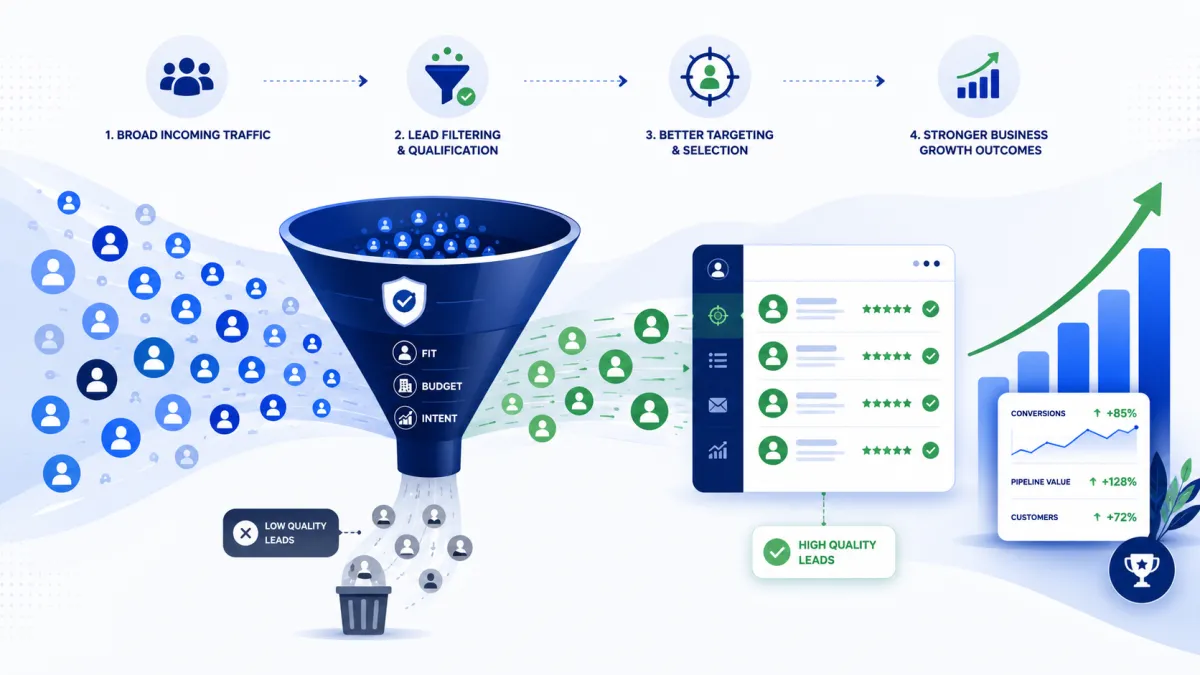
How to Generate Higher-Quality Leads Instead of More Leads
Lead Generation, Lead Quality, Marketing Strategy, Sales Conversion
Stop Chasing More Leads. Start Attracting Better Ones.
For many growing businesses, the problem is not simply a lack of leads. It is that too many inquiries are outside the service area, cannot afford the offer, misunderstand what the business provides, or are nowhere near ready to make a decision.
The sales team becomes busier without becoming more productive. Strong opportunities receive less attention because they are buried among low-intent contacts, poor-fit inquiries, and people who only want free information.
Generating more leads can make this problem worse. The better goal is to attract more of the right people, identify genuine buying intent earlier, and give each prospect a next step that matches their readiness.
Higher-Quality Leads vs. More Leads: Why the Difference Matters
When your pipeline is full of low-intent contacts, your team spends time chasing people who were never likely to buy. The result is bloated lists, frustrated sales reps, and wasted ad spend. By intentionally designing your marketing to generate higher-quality leads rather than more leads, you create a pipeline in which each conversation has a real chance of becoming business.
Start With a Clear, Practical Ideal Customer Definition
Quality begins with clarity. If “anyone with a credit card” can be your customer, your marketing will attract a crowd of mismatched prospects. Instead, clearly define your ideal customer in terms your marketing and sales teams can both use:
Firmographics: industry, company size, location (for LeadMagno, that’s Canadian businesses first).
Roles: who actually drives the purchase — owner, marketing manager, or operations lead?
Readiness: What triggers make them actively seek a solution now?
Tightening the ideal-customer definition can improve lead quality by making campaigns more relevant and reducing obvious mismatches.
Target Specific Problems, Not Generic Interest
High-intent leads are usually wrestling with a clear problem. Instead of promoting “better marketing” or “more customers,” speak directly to specific problems your best customers feel every day:
“Leads are slipping through the cracks because follow-ups aren’t automated.”
“Paying for ads but not knowing which campaigns actually generate customers.”
“Using five different tools to manage one customer journey.”
When your messaging is problem-specific, the people who respond are far more likely to have a genuine need and intent to solve it — exactly the lead your sales team wants.
Align Messaging, Offers, and Landing Pages Around Intent
Every touchpoint — ad, email, landing page, and offer — should work together to attract prospects with genuine needs and intent. That means:
Your ad promise is repeated and expanded on the landing page, not replaced by something vague.
Your offer matches where the lead is in their journey — a demo for ready buyers, an audit or guide for earlier-stage researchers.
Your form questions subtly confirm fit (e.g., “How many leads do you currently manage per month?”).
A connected system helps preserve these intent signals by keeping forms, landing pages, qualification information, conversations, and follow-up activity together. LeadMagno can then step in as the platform that brings these pieces into one place.

More specifically, intent-based messaging may reduce total lead volume while increasing the proportion of relevant opportunities.
A Realistic Lead-Quality Example
Imagine two commercial cleaning companies running advertising campaigns in Calgary.
The first promotes “affordable cleaning services” to a broad local audience. Its form asks only for a name and phone number. It receives a high number of inquiries, but many are for residential cleaning, one-time jobs, locations outside its service area, or projects below its minimum contract size.
The second company promotes recurring commercial cleaning for offices, clinics, and professional facilities. Its landing page explains the service model and asks for the facility type, location, approximate size, and desired start date.
The second campaign may produce fewer total inquiries. However, the sales team receives better context and begins more conversations with people who understand the offer and meet the service criteria.
The difference is not just targeting. It is the alignment between the audience, problem, message, offer, landing page, qualification process, and follow-up.
Qualify Inquiries Without Adding Friction
Many businesses swing too far: either they ask for almost no information (creating noise), or they overload forms and scare good leads away. The goal is to qualify inquiries without friction by:
Asking 2–4 smart questions that reveal budget, urgency, and fit without feeling like an interrogation.
Using multiple-choice answers where possible to speed completion and standardize data.
Letting automation route and score leads in your CRM based on their responses and behaviour.
💡 Pro Tip: If form completion drops after adding a question, test rephrasing it or moving it to a follow-up email rather than removing the qualification entirely.
Track Source Effectiveness, Not Just Clicks
A campaign that generates 200 leads at a low cost can look impressive — until you realize only two ever become customers. To truly optimize quality, you must track source effectiveness all the way from first touch to closed deal:
Tag every lead with its source and campaign in your CRM.
Compare not just lead volume, but show-up rates, proposal rates, and close rates by source.
Reinvest in the channels that consistently bring in high-intent, high-converting leads.
Connected reporting helps businesses identify which campaigns create qualified conversations and revenue.
Separate Different Lead Intents to Improve Sales Outcomes
Not every lead wants the same thing. Some are ready to talk to sales today; others want a resource or price range. By separating different lead intents, you can tailor follow-ups and avoid burning out your list:
Sales-ready: “Book a demo” or “Request a quote” forms — send to your sales team immediately.
Research stage: downloads, webinars, or newsletter signups — nurture with education first.
Existing customers: upsell and retention campaigns — route differently from net-new leads.
In LeadMagno, you can build separate pipelines and automation paths for each intent, so sales only sees leads that truly belong in a sales conversation.
Learn From Every “No”: Why Disqualified Leads Matter
Every time a lead is marked as “not a fit” or “no decision,” there’s a story. When you consistently record why leads are disqualified, patterns appear:
Too small, wrong industry, or outside your service area? Tighten your targeting and copy.
No budget or wrong expectations? Adjust your pricing signals and pre-qualification questions.
Not ready yet? Move them into a nurture track instead of closing the door.
LeadMagno lets your sales team quickly tag disqualification reasons, feeding real-world data back into your marketing strategy so quality improves over time.
Align Marketing and Sales Definitions of a “Good Lead”
One of the biggest barriers to performance is misalignment. Marketing celebrates “MQLs” while sales complain they’re unqualified. The fix is to align marketing and sales definitions of lead quality:
Agree on what information is required before a lead is handed to sales.
Define clear criteria for fit, budget, and timing that both teams accept.
Review closed-won and closed-lost deals together to refine the definition regularly.
With LeadMagno, shared dashboards and standardized stages keep marketing and sales working from the same playbook, not competing scorecards.
The LeadMagno QUALITY Framework for Evaluating Lead Quality
Lead Quality Audit
Better Leads Create Better Sales Conversations
More leads can make a business appear busy. Higher-quality leads make the business more productive.
The difference comes from clarity: who the business serves, what problem it solves, what the offer includes, what information is needed, how quickly the lead should be contacted, and which outcomes should be measured.
The goal is not to convince every visitor to submit a form.
It is to help the right prospect recognize that the business understands their problem and may be the right solution.
Focus Your Team on the Opportunities Most Likely to Convert
A large contact database does not automatically create revenue. Growth comes from attracting relevant prospects, identifying intent, responding quickly, following up consistently, and understanding which campaigns produce real customers.
LeadMagno brings lead capture, qualification, conversations, automated follow-up, appointment booking, pipeline management, and performance tracking into a single connected system.
Book a free LeadMagno demo to see how your business can reduce low-quality inquiries and focus more attention on opportunities with genuine conversion potential.
Frequently Asked Questions About Lead Quality and LeadMagno
How is a “high-quality” lead different from a regular lead?
A high-quality lead is a contact that matches your ideal customer profile, has a clear problem you can solve, and shows real buying intent. They are more likely to book an appointment, accept a proposal, and become a profitable long-term client — which is exactly what LeadMagno is designed to help you identify and prioritize.
Will focusing on quality instead of volume reduce my overall sales?
You may see fewer total inquiries, but you should see more meaningful conversations and a higher close rate. For most small and medium-sized businesses, this leads to more revenue with less effort because your team spends time with the right prospects instead of chasing unqualified contacts.
Is LeadMagno only for Canadian businesses?
LeadMagno is built with Canadian businesses in mind first — from local service areas to regional compliance considerations. However, the platform and the QUALITY Framework can also support businesses operating in multiple regions or planning to expand beyond Canada.
Do I need a dedicated marketing team to use LeadMagno effectively?
No. LeadMagno is designed for busy owners, lean teams, and growing marketing departments. You can start with simple automations — like basic follow-ups and appointment bookings — and layer in more advanced campaigns as your team and strategy evolve.
Can LeadMagno replace multiple tools we’re already using?
In many cases, yes. LeadMagno brings together CRM, email and SMS campaigns, pipelines, forms, and appointment scheduling into a single platform. This reduces tool sprawl, lowers subscription costs, and makes it easier to track lead quality from first touch to closed customer.
How quickly can we start seeing improvements in lead quality?
Many businesses notice clearer conversations and fewer mismatched inquiries within the first few weeks after tightening their ideal customer profile, adjusting messaging, and using LeadMagno to qualify and route leads. The more consistently you capture data and apply the QUALITY Framework, the faster your results improve.
📌 Key Takeaway: If you’re unsure where to start, a short LeadMagno demo can help you map your current lead flow and identify the quickest wins for improving lead quality.


