Top Digital Marketing Tools for Beginners 2026
Digital Marketing, Beginner Tools, Lead Management
The Best Digital Marketing Tools for Beginners in 2026 (And How to Turn Them into a Simple System)
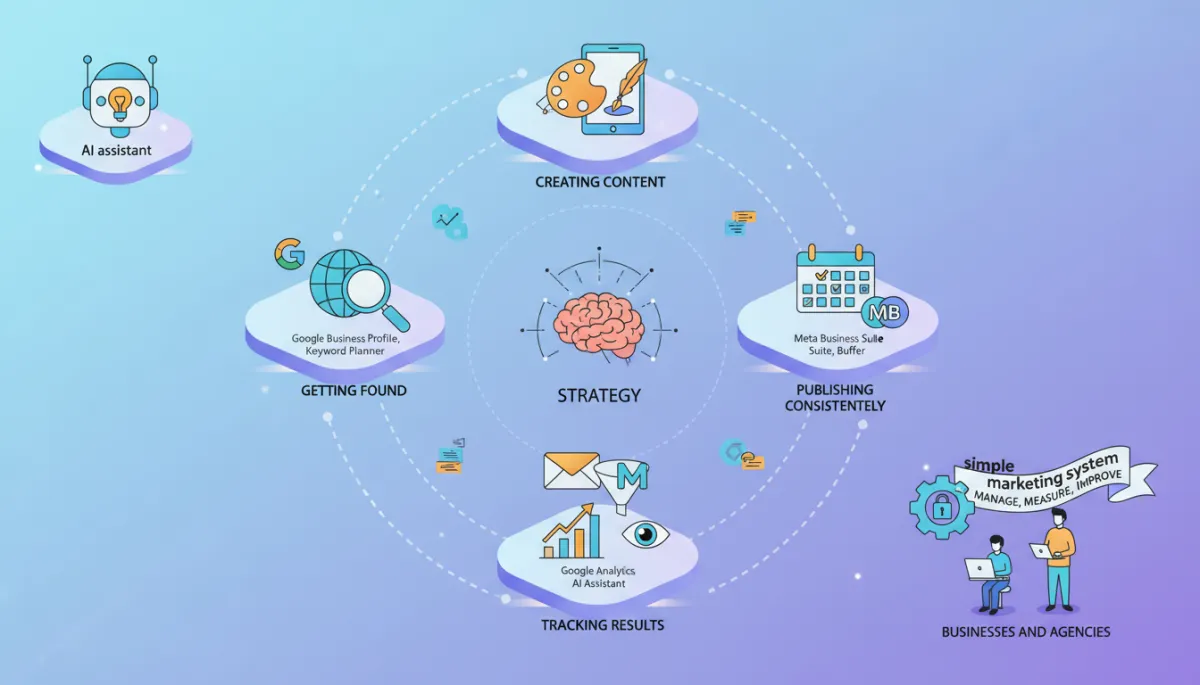
The most powerful marketing stack for 2026 isn't about having the most tools—it's about having a clear strategy and a simple system that helps you get found, create content, publish consistently, capture leads, and track results. For Canadian businesses and agencies, that's exactly where LeadMagno and a focused set of beginner‑friendly tools come in.
📌 What You'll Learn
✔ The essential marketing tools every beginner should start with
✔ How to avoid buying unnecessary software and scattered subscriptions
✔ How to build a simple marketing system that works together end‑to‑end
✔ Which tools work best together for Canadian businesses
✔ How to capture and follow up with leads automatically using a CRM like LeadMagno
✔ How to measure what's actually working so you can protect your marketing budget
Start with strategy, not software
Too many beginners make the same mistake: they sign up for every "must‑have" app, burn hours testing features, and still don't know what's actually working. Tools without a clear plan only create noise and wasted budget. Before you touch a single platform, clarify three things:
Who you want to reach and where they spend time online.
What problems do you solve, and what offers will you promote?
How you'll move people from first touch to a booked call or sale.
If you need help mapping that out, a digital consultancy session or a structured content marketing strategy workshop can save you months of trial and error. Once the strategy is clear, the tools below become a simple, connected marketing system instead of a scattered collection of logins.
💡 Beginner Mistakes to Avoid
• Buying too many tools without a clear plan
• Not setting up a CRM to track and nurture leads
• Ignoring Google Business Profile for local visibility
• Creating content without a strategy or calendar
• Never measuring results in Google Analytics or your CRM
• Relying on manual follow‑up instead of simple automations
• Skipping email marketing and relying only on social media
• Switching software every month instead of committing to a stack
• Letting leads sit in inboxes, spreadsheets, or sticky notes
Step 1: Get found – search and local visibility
For most buyers, the journey still starts with Google. That makes three free tools non‑negotiable in 2026.
Google Business Profile
Your Google Business Profile (GBP) is your local storefront on Search and Maps. In 2026, it's more powerful than ever: regular posts, fresh photos, and recent reviews now heavily influence how often you appear in local results. With the new Analytics integration, you can pull calls, direction requests, and website clicks directly into Google Analytics, making it easier to see how local visibility turns into real leads (support.google.com).
Google Search Console & Google Keyword Planner
Google Search Console shows which queries bring people to your site, which pages get impressions, and where you're buried on page two or three. Pair it with Google Keyword Planner to find search terms your ideal customers actually use and to prioritize content topics. For a beginner, this combination is the simplest way to align your website and blog with real demand instead of guessing.
Step 2: Create content – fast, on‑brand assets
Once you know what people search for, you need content that answers their questions and showcases your expertise.
Canva + an AI assistant for content and planning
Canva remains the go‑to design tool for non‑designers. In 2026, its AI features make it even easier for beginners: you can turn a brand kit into ready‑to‑use social templates, resize designs for multiple channels, and quickly produce professional graphics for ads, emails, and blog headers.
Pair Canva with an AI assistant like ChatGPT or Gemini to brainstorm campaign ideas, draft post captions, outline blog articles, and plan content calendars. Used well, AI doesn't replace your voice; it accelerates the planning and first‑draft stage so you can focus on refining and publishing. Many successful beginners now build a simple workflow: AI for outlines and copy, Canva for visuals, and then straight into scheduling.

A simple calendar, plus the right tools, keeps your content consistent all year.
Step 3: Publish consistently – social media made manageable
Consistency beats intensity. Instead of posting in bursts and disappearing for weeks, use a scheduling tool to batch your content and stay visible.
Meta Business Suite or Buffer
If most of your audience is on Facebook and Instagram, Meta Business Suite gives you native scheduling, inbox management, and basic analytics in one place. If you're active across multiple networks, Buffer offers a clean, beginner‑friendly interface to schedule posts, recycle top content, and monitor engagement across channels. Either way, pairing a scheduler with a documented plan—often created with help from an AI assistant—turns social media management into a predictable weekly task instead of a daily scramble.
📌 Beginner Marketing Stack at a Glance
Step 4: Capture and nurture leads – from clicks to conversations
Traffic and followers only matter if they turn into contacts, conversations, and customers. This is where email marketing and a CRM come together.
Mailchimp for email campaigns
Mailchimp remains a strong starting point for beginners thanks to its drag‑and‑drop builder, templates, and growing AI capabilities. In 2026, features like Analytics AI and AI‑assisted campaign drafting help small teams understand which emails drive revenue and how to improve them (mailchimp.com). While the free plan is now more limited, even a modest paid tier can be a smart investment once you're serious about email.
LeadMagno: your central CRM and marketing hub
A CRM like LeadMagno brings everything together. Instead of scattering contacts across spreadsheets, inboxes, and ad platforms, LeadMagno gives Canadian businesses a single dashboard to:
Capture leads from forms, landing pages, and ads automatically.
Automate follow‑ups via email and SMS so no lead slips through the cracks.
Track every conversation, from first click to closed deal, in one timeline.
Offer online appointment booking so prospects can book calls 24/7.
Manage your sales pipeline with clear stages, values, and probabilities.
Trigger missed‑call text‑back automation so you never lose a hot lead.
Hold two‑way SMS conversations from a shared inbox your whole team can use.
Use built‑in AI assistance to draft replies, follow‑ups, and campaigns faster.
LeadMagno is built specifically to help Canadian businesses attract, engage, and retain customers using smart automation and streamlined communication. That means fewer missed follow‑ups, fewer lost leads, and clearer insight into which campaigns actually generate revenue.
🗓️ A Simple Monthly Marketing Workflow
Week 1: Research keywords in Keyword Planner and review Search Console queries.
Week 2: Create blog posts, landing pages, and Canva graphics based on that research.
Week 3: Schedule social posts in Meta Business Suite or Buffer and set up email campaigns in Mailchimp.
Week 4: Review GA4, LeadMagno, and Mailchimp analytics, then improve campaigns and automations for next month.
Step 5: Track results – know what's working
The final piece of a simple marketing system is measurement. Without it, you're guessing. With it, you can double down on what works and cut what doesn't.
Google Analytics and Zapier for connected reporting
Google Analytics 4 (GA4) shows you where visitors come from, what they do on your site, and which pages or campaigns lead to form fills or purchases. When you connect GA4 with your Google Business Profile and Search Console, you get a clear view of how search, local, and content work together to drive traffic and leads.
Zapier then acts as the glue between tools. You can automatically send new form submissions into LeadMagno, add Mailchimp subscribers to the right list, or log key events into a reporting sheet—without manual copying and pasting. For beginners, a few well‑designed Zaps can eliminate repetitive admin and keep your data flowing into one system of record.
💰 Estimated Monthly Costs for a Beginner Stack
From scattered tools to a simple, effective marketing system
The best digital marketing tools for beginners in 2026 are the ones you'll actually use—and connect. A practical starter system for a small business or agency might look like this:
Getting found: Google Business Profile, Google Search Console, Google Keyword Planner.
Creating content: AI assistant for ideas and copy, Canva for visuals.
Publishing consistently: Meta Business Suite or Buffer for scheduled social posts.
Capturing leads: Mailchimp forms and automations feeding into a CRM like LeadMagno.
Tracking results: Google Analytics plus Zapier automations and CRM reporting.
🚀 If You're Starting Today
Week 1 – Create: Set up your Google Business Profile and complete every field.
Week 2 – Install: Add GA4 to your website and verify Google Search Console.
Week 3 – Create: Build a small set of reusable Canva templates for social and email.
Week 4 – Set up: Launch your LeadMagno CRM, connect your forms, and create your first email automation in Mailchimp.
Avoid the common beginner trap of over‑signing up for tools without a strategy. Instead, define your goals, choose one reliable tool for each core job, and connect everything into a simple, measurable system. That's how you stop losing leads, protect your marketing budget, and build a marketing engine that quietly works in the background while you focus on serving clients.
Successful marketing isn't built on dozens of disconnected tools. It's built on a simple system where every tool has a purpose, every lead is tracked, and every opportunity receives timely follow‑up. Once those pieces work together, marketing becomes easier to manage, easier to measure, and far more profitable for Canadian businesses.
If you're ready to centralize your leads, automate follow‑ups, and finally see which campaigns drive real revenue, book a free demo of LeadMagno today and see how a purpose‑built Canadian marketing CRM can transform your marketing system end‑to‑end. From what happens after someone fills out your website form to CRM automation for small businesses, lead tracking, lead management systems, Google Ads vs. Meta Ads, local SEO for Calgary businesses, AI search optimization, and conversion rate optimization, LeadMagno and our team give you a clear path to a smarter, more profitable marketing system.


