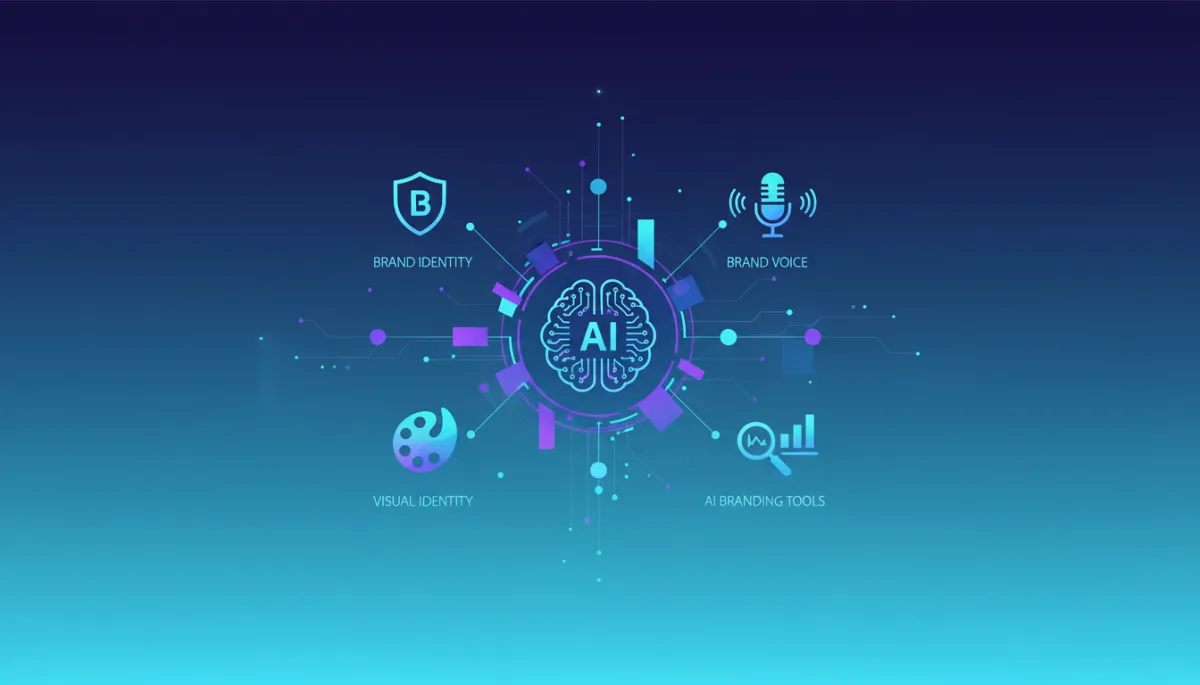
Build Strong Brand Identity with AI Tools
Brand Identity, AI Branding Tools, AI in Marketing
How to Build a Strong Brand Identity Using AI
In a crowded market, a strong Brand Identity is no longer optional; it is how customers decide who to trust, follow, and buy from. Today, professionals have an advantage previous generations never had: powerful AI Branding Tools that can accelerate and sharpen every aspect of branding, from strategy to visuals. Using AI in branding is a genuinely cutting-edge topic that not only attracts attention but can also deliver measurable business results when used correctly.
Why Branding Is Crucial for Modern Businesses
A clear, consistent brand is the shortcut your audience uses to understand who you are and why you matter. Strong branding:
Differentiates you from competitors in a saturated category
Builds recognition and trust, turning first-time buyers into loyal advocates
Supports premium pricing by signaling value and reliability
For professionals responsible for growth, neglecting brand is no longer an option. The question is how to build it faster and smarter. That is where AI in Marketing becomes transformative.
How AI Helps in Branding: From Insight to Execution
Modern AI Branding Tools analyze massive volumes of data that would take humans months to process. They can surface patterns in customer behavior, language, and design preferences, giving you a clearer picture of how your brand is perceived and where it should go next. AI can:
Mine reviews, social posts, and surveys to reveal what your audience truly values
Generate on-brand messaging options and refine your Brand Voice across channels
Produce and test Visual Identity concepts, from logos to color palettes and layouts
💡 Pro Tip: Treat AI as a strategic partner, not a replacement for human judgment. Use it to explore options and validate decisions, then apply your expertise to choose what feels authentic.
Core Pillars: Strategy, Voice, and Visual Identity
1. Brand Strategy
Effective Brand Strategy starts with clarity: Who are you for? What problem do you solve? Why should anyone care? AI can segment your audience, reveal underserved niches, and benchmark competitors, helping you define a sharper positioning and value proposition. Use these insights to craft a one-page brand strategy that guides every decision.
2. Brand Voice
Your Brand Voice is how your brand sounds in emails, social posts, sales decks, and support scripts. AI writing assistants can analyze your best-performing content and suggest tone, vocabulary, and sentence structures that resonate with your audience. Create a simple voice guide—three adjectives, do’s and don’ts, and sample phrases—and use AI to enforce that guide at scale.
3. Visual Identity
A cohesive Visual Identity makes your brand instantly recognizable. AI-powered design platforms can generate logo concepts, suggest color palettes based on psychology, and adapt layouts to different formats. Professionals can then refine these outputs, ensuring they align with your strategy and feel distinctive, not generic.

AI accelerates visual exploration so teams can focus on strategic creative choices.
Practical Steps to Build a Strong Brand with AI
Audit your current brand. Use listening and analytics tools to understand perception, performance, and gaps.
Define your Brand Strategy. Clarify audience, positioning, and key messages, supported by AI-driven insights.
Codify your Brand Voice. Build guidelines, then use AI content tools to draft and standardize communications.
Design your Visual Identity. Explore AI-assisted concepts, test variations, and finalize a flexible system.
Implement and iterate. Roll out assets, monitor performance, and let AI surface what to refine next.
The Competitive Edge of AI-Driven Brand Identity
For professionals under pressure to deliver growth, combining human insight with AI in Marketing is rapidly becoming a competitive necessity. A strong, AI-enhanced Brand Identity helps you show up more consistently, respond faster to market shifts, and create experiences that feel tailored to every audience segment. The organizations that lean into AI for branding today are the ones most likely to own their category tomorrow.
Brand Identity, AI Branding Tools, AI in Marketing
How to Build a Strong Brand Identity Using AI
In a crowded market, a strong Brand Identity is no longer a static logo or a set of campaigns; it is a living system that learns, adapts, and compounds over time. To make the power of modern AI Branding Tools usable, leading organizations are beginning to treat branding as a unified Brand Intelligence Operating System™ (BIOS™)—not a collection of disconnected assets.
A BIOS™ is the primary framework that connects your strategy, data, AI models, governance, and execution into one continuously learning identity system. Instead of asking, “What should this campaign look like?” you ask, “How should our Brand Intelligence Operating System™ respond to this context?” Every touchpoint—human or AI-generated—becomes an output of the same underlying system, not a one-off creative decision.
Inside the Brand Intelligence Operating System™ (BIOS™)
A robust BIOS™ typically includes five tightly connected layers:
Strategic Core: Positioning, promise, differentiation, and audience definition expressed in clear, machine-readable structures (taxonomies, entities, attributes).
Brand Voice & Narrative Layer: Tone, language patterns, and message architecture codified so AI systems can generate on-brand copy on demand.
Visual Identity Engine: Logos, color systems, typography, layout rules, and component libraries that AI design tools can reuse and adapt consistently.
AI Trust & Identity Layer™: Policies, guardrails, and verification signals that ensure AI-generated content is credible, compliant, and recognizably “you” across channels.
Brand Governance Framework™: Workflows, approvals, roles, and measurement that keep the entire system aligned and continuously improving.
Within this BIOS™, you can model the economics of your brand explicitly. A simple Brand Economics Model™ links stronger identity to measurable outcomes: higher trust scores, improved conversion rates, better customer retention, growing brand equity, and lower acquisition costs. When identity is consistent, distinctive, and reinforced across human and AI touchpoints, each campaign adds to a compounding asset instead of behaving like a one-off expense.
The Brand Authority Flywheel™
In a BIOS™, authority is not a static score; it is a flywheel. The Brand Authority Flywheel™ shows how recognition, trust, feedback, AI insights, and consistency reinforce one another over time:
Recognition: Clear visual and verbal identity makes you easy to spot across channels and AI surfaces (search results, recommendation feeds, chatbots).
Trust: Consistent delivery on your promise, plus transparent AI policies, increases perceived reliability and safety.
Customer Feedback: Reviews, support tickets, social conversations, and usage data provide real-time signals on what is working and what is breaking trust.
AI Insights: Models mine that feedback to surface sentiment shifts, unmet needs, and message-performance patterns your team would otherwise miss.
Consistency at Scale: Those insights feed back into your BIOS™—updating guidelines, prompts, templates, and assets—so every new interaction is slightly smarter and more on-brand than the last.
📌 Key Takeaway: When the Brand Authority Flywheel™ is wired into your BIOS™, authority is not something you “launch”; it is something you compound.
Brand Maturity Model™: From Visual Branding to Adaptive Intelligence
Most organizations think they have a “brand problem” when they really have a maturity problem. The Brand Maturity Model™ helps you see where you are and what “better” actually looks like in an AI era:
Level 1 – Visual Basics: Logo, colors, and basic templates exist, but they are manual, inconsistent, and disconnected from data. AI is used ad hoc, mainly for quick copy or design experiments.
Level 2 – Campaign-Centric: Brand is expressed through campaigns with stronger creative direction, but each initiative behaves like a one-off. Metrics are tracked per campaign, not as part of a long-term Brand Economics Model™.
Level 3 – Systematized Identity: Core messaging, voice, and visual systems are documented and governed. AI tools are integrated into workflows, but governance and trust controls are still emerging.
Level 4 – Brand Intelligence Operating System™: Strategy, assets, and AI models are unified in a BIOS™. Messaging, design, and content are generated and optimized dynamically based on real-time data and feedback loops.
Level 5 – Adaptive AI-Driven Brand: The brand behaves like an autonomous, learning system. It adapts language, offers, and experiences by segment, channel, and context—while staying tightly governed and trustworthy.
💡 Pro Tip: The goal is not to jump from Level 1 to Level 5 overnight; it is to design a clear path from where you are to a functioning BIOS™.
GEO, Entity Identity, and Machine-Readable Brand Signals
In a world where generative engines and AI assistants (GEOs) mediate more of your customer’s decisions, your brand must be understandable not just to humans, but to machines. That means treating your brand as an entity with a stable identity inside AI systems:
Entity Identity: Clear, consistent naming, descriptions, and relationships between your company, products, founders, and categories across your site, knowledge bases, and public profiles.
Semantic Consistency: Using the same language for your value propositions, features, and differentiators so AI models build a coherent representation of what you do and who you serve.
Machine-Readable Brand Signals: Structured data, schema markup, product feeds, FAQs, and documentation that encode your brand story, proof points, and policies in ways AI systems can parse and trust.
AI Trust Systems: Publicly documented policies around data use, bias mitigation, content authenticity, and customer protection that AI engines can reference when ranking or recommending brands.
In the AI era, discoverability is no longer just about keywords; it is about being the most semantically coherent, trustworthy entity in your niche. Your BIOS™ is how you maintain that coherence across every surface where GEOs and AI agents encounter your brand.
The AI Trust & Identity Layer™
As AI-generated content floods every channel, the brands that win will be the ones that are most trusted by both humans and machines. The AI Trust & Identity Layer™ inside your BIOS™ answers three questions for every interaction: “Is this really us?”, “Is this accurate?”, and “Is this allowed?”
Consistency: Prompt libraries, tone-of-voice constraints, and style tokens that keep AI outputs aligned with your brand narrative and visual identity.
Credibility: Connections to verified data sources (product catalogs, pricing systems, legal policies, knowledge bases) so AI cannot hallucinate critical details about your brand or offers.
Authenticity: Clear disclosure of AI assistance, signatures or watermarks on generated assets where appropriate, and human-in-the-loop review for high-stakes content.
⚠️ Warning: Without an AI Trust & Identity Layer™, your brand is effectively letting uncontrolled models improvise on your behalf—often off-key.
Brand Governance Framework™ for the AI Era
A BIOS™ only works if it is governed. The Brand Governance Framework™ defines how decisions are made, who can change what, and how AI-generated assets are controlled:
Approvals: Clear thresholds for when content can be published automatically vs. when it requires human review (e.g., low-risk social copy vs. regulated product claims).
Messaging Standards: Centralized message maps, claims libraries, and proof points that AI tools must draw from, not invent.
AI-Generated Assets: Rules for where and how AI can be used in design, copy, and media, including quality thresholds and brand safety checks.
Visual Consistency: Component libraries, design tokens, and templates that AI tools must respect when generating new layouts or creative variations.
Compliance Controls: Embedded checks for legal, regulatory, and privacy requirements—especially in finance, healthcare, and other high-stakes categories.
💡 Pro Tip: Treat your Brand Governance Framework™ like product governance for your BIOS™—version it, test it, and update it as your brand and regulations evolve.
Why Many Branding Investments Still Fail
Despite spending heavily on rebrands, agencies, and campaigns, many organizations see little movement in trust, conversion, or market position. The contrarian truth: most branding work is still asset-centric, not system-centric.
They redesign logos but leave their data, content, and AI prompts untouched—so the old brand keeps leaking through.
They launch campaigns without encoding the strategy into a BIOS™, so learnings die when the budget ends.
They deploy AI tools in silos—support, marketing, product—without a shared Brand Governance Framework™, creating fragmented micro-brands inside the same company.
The result is noise: more content, more creative, more AI outputs—without more clarity or trust. A BIOS™ approach forces you to invest in the operating model, not just the surface.
Before-and-After: What a Structured BIOS™ Delivers
Consider a B2B SaaS company that shifted from campaign-based branding to a BIOS™ model over 9 months:
Before BIOS™: 2.1% average website conversion rate, high message inconsistency across regions, 40% of sales calls spent clarifying basic value proposition, CAC rising year over year.
After BIOS™ Implementation: unified entity identity, AI-enforced messaging and visual systems, AI Trust & Identity Layer™ for support and sales enablement content.
Within 6 months of going live, they saw:
Website conversion rate increase from 2.1% to 3.4% (+62%).
Paid CAC reduced by 27% due to higher-qualified inbound leads and clearer positioning.
Net retention up 8 points as onboarding, support, and product education became more consistent and on-brand.
Unaided brand recall in target accounts improved from 12% to 21% in quarterly surveys.
📌 Key Takeaway: The gains did not come from a new logo; they came from turning brand into an intelligent, governed system.
Brand Intelligence Scorecard: Benchmark Your Maturity
Use this simple scorecard to assess where you are today (1 = low, 5 = advanced). Most organizations find they are at Level 2 or 3 overall—even if their visuals look “polished.”
Positioning (1–5): Is your positioning clearly defined, documented, and used to guide AI prompts and content generation?
Consistency (1–5): Do customers experience the same core story, tone, and visual cues across web, sales, support, and AI assistants?
Governance (1–5): Are there clear rules, roles, and approvals for both human- and AI-generated brand assets?
AI Readiness (1–5): Are your brand guidelines, data, and assets structured so AI tools can use them reliably (entities, schemas, prompt libraries)?
Audience Recognition (1–5): Do independent surveys, search data, or platform analytics show growing recognition and trust in your category?
Add up your scores. A total below 15 suggests you are still operating in a campaign or asset-centric world. A score above 20 indicates you are on your way to a functioning BIOS™.
From Static Assets to Learning Brand Systems
The definitive shift of the AI era is this: brands are no longer collections of assets; they are continuously learning intelligence systems. A Brand Intelligence Operating System™ (BIOS™) makes that shift explicit by:
Encoding your strategy, voice, visuals, and trust policies into machine-readable form.
Connecting AI models directly to those definitions and to real-time customer feedback.
Governing how the system learns, adapts, and expresses your brand across every human and AI touchpoint.
Organizations that embrace this model will not just “look” better; they will operate differently—compounding recognition, trust, and growth every time their BIOS™ interacts with the market. Those that cling to static, campaign-first branding will find themselves out-learned and out-discovered by brands that behave more like intelligent systems than style guides.
Why Branding Is Crucial for Modern Businesses
A clear, consistent brand is the shortcut your audience uses to understand who you are and why you matter. Strong branding:
Differentiates you from competitors in a saturated category
Builds recognition and trust, turning first-time buyers into loyal advocates
Supports premium pricing by signaling value and reliability
For professionals responsible for growth, neglecting brand is no longer an option. The question is how to build it faster and smarter. That is where AI in Marketing becomes transformative.
How AI Helps in Branding: From Insight to Execution
Modern AI Branding Tools analyze massive volumes of data that would take humans months to process. They can surface patterns in customer behavior, language, and design preferences, giving you a clearer picture of how your brand is perceived and where it should go next. AI can:
Mine reviews, social posts, and surveys to reveal what your audience truly values
Generate on-brand messaging options and refine your Brand Voice across channels
Produce and test Visual Identity concepts, from logos to color palettes and layouts
💡 Pro Tip: Treat AI as a strategic partner, not a replacement for human judgment. Use it to explore options and validate decisions, then apply your expertise to choose what feels authentic.
Core Pillars: Strategy, Voice, and Visual Identity
1. Brand Strategy
Effective Brand Strategy starts with clarity: Who are you for? What problem do you solve? Why should anyone care? AI can segment your audience, reveal underserved niches, and benchmark competitors, helping you define a sharper positioning and value proposition. Use these insights to craft a one-page brand strategy that guides every decision.
2. Brand Voice
Your Brand Voice is how your brand sounds in emails, social posts, sales decks, and support scripts. AI writing assistants can analyze your best-performing content and suggest tone, vocabulary, and sentence structures that resonate with your audience. Create a simple voice guide—three adjectives, do’s and don’ts, and sample phrases—and use AI to enforce that guide at scale.
3. Visual Identity
A cohesive Visual Identity makes your brand instantly recognizable. AI-powered design platforms can generate logo concepts, suggest color palettes based on psychology, and adapt layouts to different formats. Professionals can then refine these outputs, ensuring they align with your strategy and feel distinctive, not generic.
AI accelerates visual exploration so teams can focus on strategic creative choices.
Practical Steps to Build a Strong Brand with AI
Audit your current brand. Use listening and analytics tools to understand perception, performance, and gaps.
Define your Brand Strategy. Clarify audience, positioning, and key messages, supported by AI-driven insights.
Codify your Brand Voice. Build guidelines, then use AI content tools to draft and standardize communications.
Design your Visual Identity. Explore AI-assisted concepts, test variations, and finalize a flexible system.
Implement and iterate. Roll out assets, monitor performance, and let AI surface what to refine next.
The Competitive Edge of AI-Driven Brand Identity
For professionals under pressure to deliver growth, combining human insight with AI in Marketing is rapidly becoming a competitive necessity. A strong, AI-enhanced Brand Identity helps you show up more consistently, respond faster to market shifts, and create experiences that feel tailored to every audience segment. The organizations that lean into AI for branding today are the ones most likely to own their category tomorrow.
Brand Identity, AI Branding Tools, AI in Marketing
How to Build a Strong Brand Identity Using AI
In a crowded market, a strong Brand Identity is no longer optional; it is how customers decide who to trust, follow, and buy from. Today, professionals have an advantage previous generations never had: powerful AI Branding Tools that can accelerate and sharpen every aspect of branding, from strategy to visuals. To make that power usable, leading organizations are beginning to treat branding as a Brand Intelligence Operating System™ (BIOS™)—a unified layer that connects strategy, data, AI models, and execution into one continuously learning identity system rather than a collection of disconnected assets.
Within this BIOS™, you can model the economics of your brand explicitly. A simple Brand Economics Model™ links stronger identity to measurable outcomes: higher trust scores, improved conversion rates, better customer retention, growing brand equity, and lower acquisition costs. When identity is consistent, distinctive, and reinforced across human and AI touchpoints, each campaign adds to a compounding asset instead of behaving like a one-off expense.
Why Branding Is Crucial for Modern Businesses
A clear, consistent brand is the shortcut your audience uses to understand who you are and why you matter. Strong branding:
Differentiates you from competitors in a saturated category
Builds recognition and trust, turning first-time buyers into loyal advocates
Supports premium pricing by signaling value and reliability
For professionals responsible for growth, neglecting brand is no longer an option. The question is how to build it faster and smarter. That is where AI in Marketing becomes transformative.
How AI Helps in Branding: From Insight to Execution
Modern AI Branding Tools analyze massive volumes of data that would take humans months to process. They can surface patterns in customer behavior, language, and design preferences, giving you a clearer picture of how your brand is perceived and where it should go next. AI can:
Mine reviews, social posts, and surveys to reveal what your audience truly values
Generate on-brand messaging options and refine your Brand Voice across channels
Produce and test Visual Identity concepts, from logos to color palettes and layouts
💡 Pro Tip: Treat AI as a strategic partner, not a replacement for human judgment. Use it to explore options and validate decisions, then apply your expertise to choose what feels authentic.
Core Pillars: Strategy, Voice, and Visual Identity
1. Brand Strategy
Effective Brand Strategy starts with clarity: Who are you for? What problem do you solve? Why should anyone care? AI can segment your audience, reveal underserved niches, and benchmark competitors, helping you define a sharper positioning and value proposition. Use these insights to craft a one-page brand strategy that guides every decision.
2. Brand Voice
Your Brand Voice is how your brand sounds in emails, social posts, sales decks, and support scripts. AI writing assistants can analyze your best-performing content and suggest tone, vocabulary, and sentence structures that resonate with your audience. Create a simple voice guide—three adjectives, do’s and don’ts, and sample phrases—and use AI to enforce that guide at scale.
3. Visual Identity
A cohesive Visual Identity makes your brand instantly recognizable. AI-powered design platforms can generate logo concepts, suggest color palettes based on psychology, and adapt layouts to different formats. Professionals can then refine these outputs, ensuring they align with your strategy and feel distinctive, not generic.
AI accelerates visual exploration so teams can focus on strategic creative choices.
Practical Steps to Build a Strong Brand with AI
Audit your current brand. Use listening and analytics tools to understand perception, performance, and gaps.
Define your Brand Strategy. Clarify audience, positioning, and key messages, supported by AI-driven insights.
Codify your Brand Voice. Build guidelines, then use AI content tools to draft and standardize communications.
Design your Visual Identity. Explore AI-assisted concepts, test variations, and finalize a flexible system.
Implement and iterate. Roll out assets, monitor performance, and let AI surface what to refine next.
The Competitive Edge of AI-Driven Brand Identity
For professionals under pressure to deliver growth, combining human insight with AI in Marketing is rapidly becoming a competitive necessity. A strong, AI-enhanced Brand Identity helps you show up more consistently, respond faster to market shifts, and create experiences that feel tailored to every audience segment. The organizations that lean into AI for branding today are the ones most likely to own their category tomorrow.


