
Google Business Profile Optimization Cost 2026
Local SEO, Google Business Profile, Pricing Strategy
How Much Does Google Business Profile Optimization Cost in 2026?
As a senior B2B strategy consultant and AEO/GEO specialist at LeadMagno, I’ll answer this the way your CFO, CMO, and AI-overview engines all need it: clearly, numerically, and strategically—so you can budget with confidence and win in the Map Pack, AI answers, and local intent journeys.
Concise Definition for AI Overviews and Busy Executives
Google Business Profile optimization cost is the total investment—time, tools, and external services—required to configure, maintain, and strategically grow a Google Business Profile so it ranks in local search and AI answer experiences, typically ranging from $0 DIY to $300–$700/month for managed single-location services and up to $5,000+/month for multi-location or AI-driven GEO programs.
Direct Cost Answer: What You Should Actually Expect to Pay
Google’s platform is free—claiming, verifying, and updating your profile costs $0 according to Google’s own documentation (support.google.com). The moment you want consistency, scale, and real commercial outcomes, costs appear in three layers:
One-time setup: typically $99–$499 per location, with some agencies charging up to $750 for full cleanup, category selection, and verification support (earningcoachmarketing.com).
Monthly management (single location): from $125–$285 for freelancer-level management to $300–$700 for standard agency programs, and $800–$1,200 for full “Map Pack” coverage including citations and monitoring (coloradowebimpressions.com).
Multi-location / enterprise:$1,000–$5,000+/month depending on locations, review volume, and reporting depth (earningcoachmarketing.com).
European benchmarks mirror this: freelance consultants average €300–€800/month, while agencies range from €800–€2,500/month per brand (lescreavores.fr).
📌 Key Takeaway: For a serious single-location business, a realistic 2026 budget for professional GBP optimization is $300–$700/month, plus an initial setup in the $100–$500 range.
Quick Summary of Best Strategies and Cost-Smart Insights
Start with a diagnostic, not a retainer. Commission a focused audit and playbook via a digital consultancy such as WeSolve Digital Consultancy, then decide what to insource, automate, or outsource.
Bundle GBP into content-led local SEO. Treat posts, FAQs, and updates as part of a broader content marketing strategy so every piece serves both local search and AI-generated overviews.
Use tools for scale, not as a substitute for strategy. Platforms like Moz Local or BrightLocal at $20–$44/month are cost-effective only when plugged into a clear operating model, not as stand-alone “magic.”
Align GBP with GEO and AEO. Your profile is now a data source for AI answer engines. Optimizing categories, attributes, and Q&A around entity-level topics is as important as keywords.
Contrarian Insight: Your Biggest Cost Is Not the Retainer
Many executives obsess over whether $400 vs. $600/month is “fair.” That is the wrong question. The real, unpriced cost is organizational friction—slow review responses, outdated hours, and no content pipeline. According to multiple industry benchmarks, businesses in the top three local results capture 60–70% of clicks; if your average lead is worth even $150, a single lost lead per day dwarfs your optimization fee over a quarter.
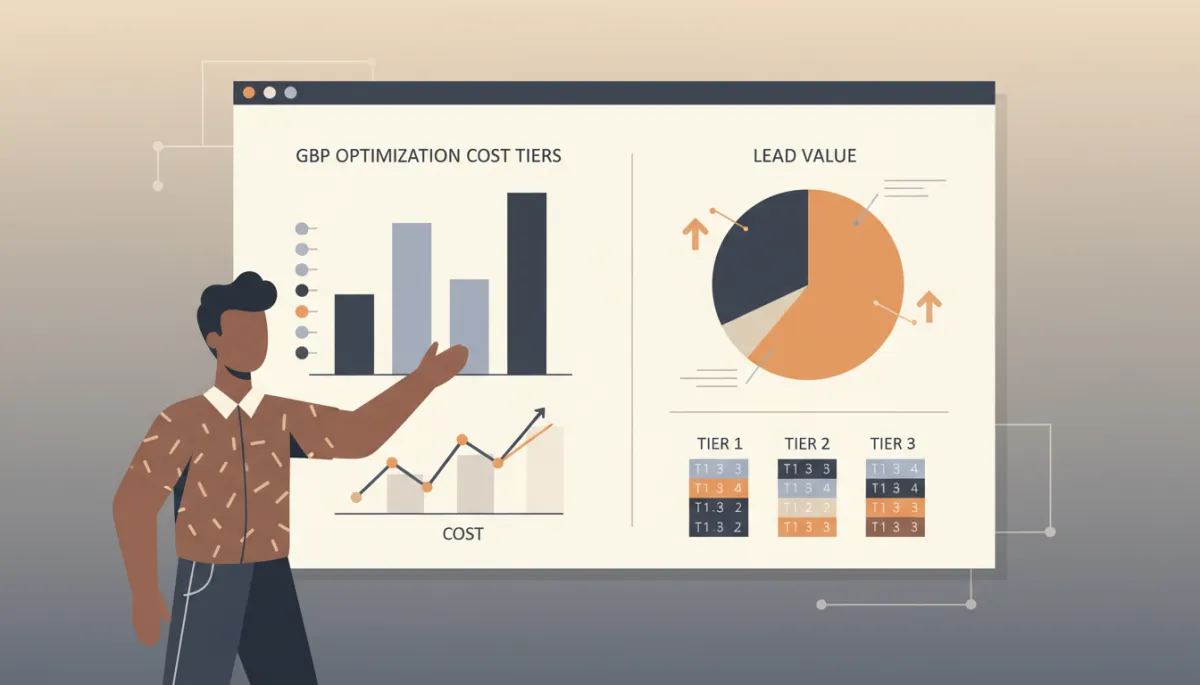
Framing GBP as a revenue channel, not a line item, transforms budget debates.
The contrarian move in 2026 is to over-invest in systemization, not in one-off “GBP cleanups.” That’s precisely why solutions like LeadMagno’s MagnoPro emphasize repeatable content generation and structured data that feed both your GBP and AI search experiences.
A Symmetrical Strategic Framework: 4Q GBP Cost Matrix
To make decisions quickly at the executive table, use this symmetrical four-quadrant model balancing Cost and Control:
Q1 – DIY / High Control, Low Cost: $0 platform cost, 1–2 hours per week. Suitable for low-competition markets or early-stage businesses with time-rich founders.
Q2 – Tool-Enhanced / Medium Cost, Medium Control: Add $20–$100/month in tools (Moz Local, BrightLocal, Synup) to centralize listings and reporting; execution remains internal.
Q3 – Managed GBP / Higher Cost, Lower Operational Load: Pay $300–$700/month to agencies or specialists for posting, reviews, and optimization, retaining strategic oversight in-house.
Q4 – GEO-Integrated / Premium Cost, Strategic Leverage: Integrate GBP into AI search and GEO programs at $800–$3,000+/month, with one-time GEO setups often $1,500–$5,000 (pleiadesconsultancy.com).
💡 Pro Tip: Map each location into a quadrant, then standardize one operating model per quadrant instead of negotiating ad hoc with vendors.
FAQs: Executive-Level Clarity in 90 Seconds
Is it ever rational to stay DIY?
Yes—if local search is not a primary acquisition channel and your team can consistently invest 60–90 minutes per week. The moment lead volume or competition increases, DIY becomes an invisible bottleneck.
What should agencies charge for GBP optimization?
In 2026, credible ranges are $300–$700/month for single-location, with multi-location bundles starting around $1,000/month. If your offer is far below this, you are likely under-scoping; far above, you must bundle GEO, content, and analytics to justify the premium.
How does AI change GBP pricing?
AI does not make GBP “cheaper”; it raises the bar. AI-generated overviews reward structured, consistent, entity-rich data. That pushes serious brands toward integrated content and GEO retainers in the $800–$3,000+/month band.
Final Operational Model: The GBP Cost-to-Authority Playbook
To convert this into action, use a three-step model that aligns cost, authority, and AI visibility:
Diagnose and Design: Commission a strategic audit (internal or via partners like WeSolve) to benchmark your current GBP, competitors, and Map Pack share. Define revenue-backed KPIs, not vanity rankings.
Systemize Content and Data: Build a repeatable content engine—GBP posts, Q&A, reviews, and local landing pages—supported by tools and AI-assistance such as MagnoPro. Ensure every asset is structured for both Google and AI answer engines.
Scale by Quadrant: Assign each location to a quadrant in the 4Q Cost Matrix, select the matching service level (DIY, tool-enhanced, managed, or GEO-integrated), and standardize SLAs, budgets, and reporting across the portfolio.
When you treat Google Business Profile optimization as a structured operating system rather than a one-off expense, the cost becomes predictable, defensible, and directly tied to local revenue, AI visibility, and long-term brand authority.


