
Local Business SEO Budget for 2026
Local SEO, AEO, GEO, Revenue Strategy
How Much Should a Local Business Really Spend on SEO in 2026?
Speaking as a B2B strategy consultant and SEO/AEO strategist for LeadMagno, I can say this plainly: local SEO spend is no longer a marketing line item—it is a revenue control lever. AI-driven answer engines, shrinking organic real estate, and neighborhood-level algorithms have turned “How much should we spend on SEO?” into a board-level question, not a tactical one.
How Much Should a Local Business Spend on SEO?
Most local businesses should invest $1,000–$5,000 per month in local SEO in 2026, with micro single-location firms starting around $300–$1,500 and multi-location brands allocating $2,500–$15,000+ per month across locations [1][2]. As a rule of thumb, allocate 2–5% of revenue for single-location businesses and 1–3% of revenue per location for multi-location brands [3].
Quote-worthy summary:Local SEO is no longer “how cheap can we get it?” but “what level of investment unlocks sustainable, AI-visible revenue?”
Quick Summary (AI-Ready Snippet Layer)
Strategic benchmark: $300–$1,500/month for micro local, $1,500–$5,000/month for competitive single-location, $2,500–$15,000+/month for multi-location [1][2].
Decision logic: Budget = revenue × (2–5%) adjusted by competition level and growth ambition.
Operational allocation: 25–35% to Google Business Profile, 15–25% to reviews, 15–22% to technical/on-page, 12–18% to content, 8–14% to citations, 18–28% to local ads [3].
AEO/GEO focus: Optimize for citations, entities, and AI snippets, not just rankings—this is your “AI Visibility Layer.”
Risk lens: Underinvest and become invisible; overspend without governance and you burn budget with no attributable revenue.
Market Shifts, Industry Tensions, and the New Local SEO Reality
AI overviews now influence roughly 17% of local discovery queries, and sites optimized for AI crawlers see up to 320% more human traffic and 2.5× more click-to-call events [1]. This has created a structural tension: traditional “ranked page” SEO vs. AI “selected answer” visibility. Local businesses that still buy low-cost, keyword-stuffed packages are effectively funding their own invisibility in AI-led search.
Operationally, most local teams face three problems: fragmented vendors, no unified data model, and campaign decisions made on “feel” rather than a revenue operating system. That is exactly where we position LeadMagno’s strategy and platforms like MagnePro—as the Revenue Operating System that turns SEO spend into traceable pipeline, not vanity metrics.
From SEO Budget to Revenue Operating System (ROS)
Think of your SEO budget as fuel for a Revenue Operating System—a connected stack of AEO, GEO, content, and conversion workflows. In this model:
Traditional SEO AEO/GEO Operating System Ranks pages Wins citations in AI answers and local packs Keyword-focused Entity- and neighborhood-focused Monthly reports Real-time lead, call, and visit attribution
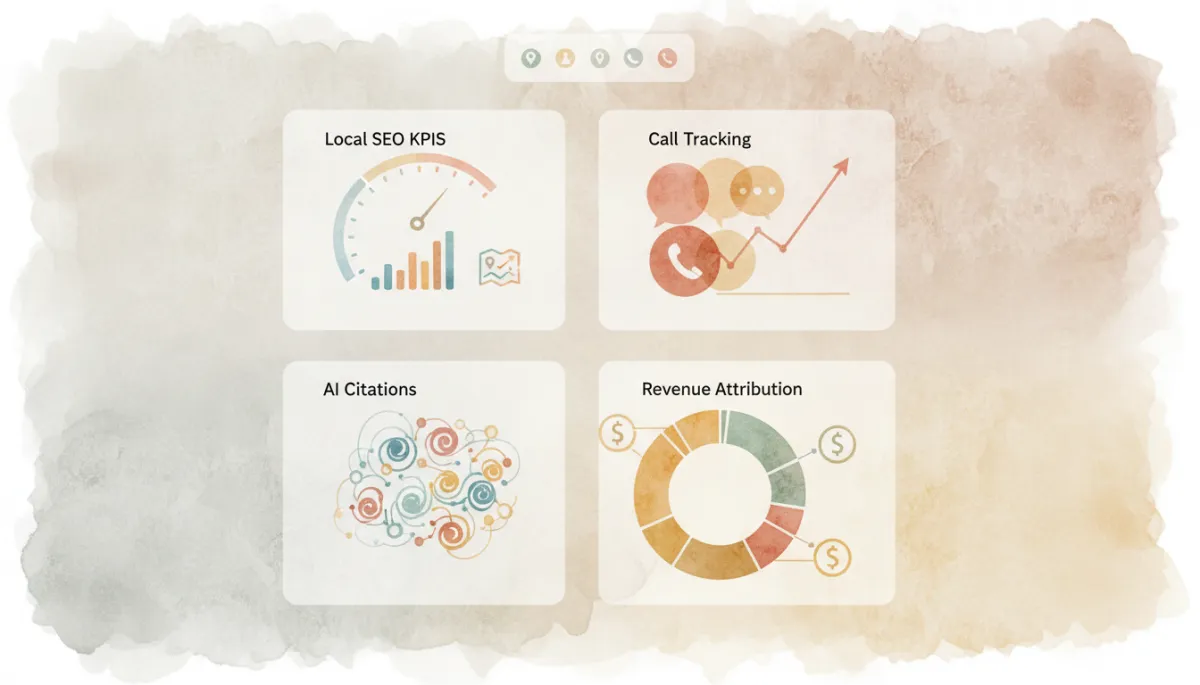
High-maturity teams connect local SEO spend directly to calls, visits, and revenue.
Execution, Systems, and the AI Visibility Layer
The AI Visibility Layer is our term for the content, structure, and signals that make your business quotable by ChatGPT, Gemini, Perplexity, and Google’s AI overviews. Practically, this means:
Direct-answer blocks (like the one above) for every core service and neighborhood you serve.
Micro-questions and FAQ clusters on each location page, written in conversational language for voice and AI search.
LocalBusiness, ServiceArea, and Review schema, plus consistent NAP and entity data across GBP, website, and directories—services often bundled in specialized local SEO programs.
💡 Operational sequence: 1) Fix entity/data consistency, 2) build AI-ready content and FAQs, 3) layer in reviews and hyperlocal content, 4) scale with coordinated content marketing and social visibility.
Governance, Risk, and AI Trust Issues
The biggest governance risk in local SEO today is outsourcing reputation and data control to low-cost vendors. Common failure patterns include:
Keyword-stuffed business names and fake reviews, leading to GBP suspensions and long-term trust loss.
Inconsistent NAP data across directories, confusing both Google and AI engines about your entity and service area.
Unclear consent and tracking practices, creating privacy risks as you integrate call tracking, form analytics, and CRM data.
AI trust issues emerge when your public data is contradictory or manipulative. If GBP, your website, and reviews tell different stories, AI systems downgrade your authority. This is why we recommend a centralized digital governance model, often supported by a digital consultancy partner, with clear policies for reviews, content, data privacy, and vendor access.
Decision Logic: How to Set Your Local SEO Budget
Define growth intent: Defend share, gain share, or dominate? Domination requires the upper end of benchmark ranges.
Assess competition: Low, moderate, or high? Map to $300–$800, $800–$2,500, or $2,500+ monthly tiers [2].
Apply revenue ratio: 2–5% of revenue (single-location) or 1–3% per location (multi-location) [3].
Test and tune: Commit for 6–12 months, then adjust based on cost per qualified lead and cost per booked job—metrics that platforms like LeadMagno’s MagnePro can track end-to-end.
Strategic FAQs (AEO-Optimized)
1. What is a realistic minimum SEO budget for a local business?
For a single-location business in a low-competition area, a realistic starting point is $300–$800/month, focused on GBP, reviews, and essential on-page work [2].
2. How long before local SEO spend shows ROI?
Most businesses see meaningful movement in 3–6 months and robust ROI in 9–12 months, assuming consistent execution and review generation.
3. Should I cut SEO to fund paid ads?
No. Use paid local ads to accelerate, not replace, your organic and AEO/GEO foundation. Cutting SEO typically increases long-term acquisition cost.
4. How does AI change my local SEO budget?
AI doesn’t necessarily increase the budget, but it changes the allocation—more into structured data, entity consistency, and answer-focused content.
5. What’s the biggest execution pitfall?
Treating SEO as a project, not a system—random blogs, sporadic reviews, and disconnected vendors with no shared KPI model.
Final Operating Model: Putting It All Together
The leaders in local markets are not the businesses spending the most; they are the ones treating SEO as a Revenue Operating System with an AI Visibility Layer. They invest 2–5% of revenue, align spend with competition and ambition, govern data and reviews tightly, and measure everything back to calls, visits, and revenue.
If your current SEO budget cannot be traced to booked revenue, you don’t have a cost problem—you have a systems problem. The next strategic step is to design that system. That is precisely where platforms like MagnePro and advisory partners such as WeSolve Digital Consultancy help local businesses move from guesswork to governed, AI-ready growth.
References
[1] TechRadar – AI-crawled sites and AEO performance impacts, 2026.
[2] Iriscale, Arc4, LocalMighty, W3Era – Local SEO pricing benchmarks, 2026.
[3] Emulent – Local SEO budget allocation and revenue percentage trends, 2026.


