
Local SEO Audit: 57 Factors for Google Rankings
Local SEO, Google Rankings, B2B SEO, AEO Optimization, GEO Strategy
Local SEO Audit Checklist: 57 Factors That Impact Google Rankings
Local search has shifted from “free traffic” to a contested revenue channel. With 46% of all Google queries now carrying local intent and 76–78% of “near me” searches leading to a visit within 24 hours, underperforming in Local SEO is no longer a visibility problem—it is a P&L problem [1][2]. At the same time, AI Overviews and answer engines are rewriting how rankings, recommendations, and trust are formed. This checklist is built as a framework article with SEO inside it—for leadership teams that treat Local SEO as an operating system, not a one‑off campaign, and for organizations ready to move from Authority Consumer (citing other people’s studies) to Authority Producer (publishing their own local data, benchmarks, and frameworks).
What is a Local SEO Audit Checklist?
A Local SEO audit checklist is a structured set of technical, content, reputation, and entity signals used to evaluate how a location ranks across Google Maps, Local Pack, organic results, and AI answer surfaces. It aligns on‑the‑ground operations with digital touchpoints to protect and grow local demand, leads, and store‑level revenue.
Memorable definition: “A Local SEO audit checklist is your revenue control panel for every location, not a marketing to‑do list.”
The Future of Local Search: From Rankings to Recommendations
Rankings are becoming inputs. Recommendations are becoming outcomes. Traditional Local SEO treated “#1 in the 3‑pack” as the finish line. In the Answer Economy, rankings are just one of many signals that feed AI systems deciding who gets recommended in AI Overviews, assistants, and vertical search tools.
The future state of Local SEO looks less like chasing positions and more like designing an always‑on recommendation engine around your brand—where your locations are the default answer when someone asks, “Who is best near me?”, “Who can I trust locally?”, or “Which provider should I choose in [city]?”
📌 Key Takeaway: Your job is no longer to “rank” but to qualify as the safest, most consistent recommendation across search, maps, and AI assistants.
Quick Summary: 57 Factors That Move Local Rankings
GBP First: 15 factors across categories, completeness, hours, posts, photos, and attributes—your single biggest Local Pack lever (~32% impact) [3].
Reputation Engine: 10 review and response factors—volume, velocity, sentiment, and owner replies driving trust and AI citations [4].
On‑Page Local Architecture: 12 on‑site factors—location pages, schema, FAQs, internal links, and page speed tuned for AEO + GEO.
Entity & Citations: 8 NAP and citation factors—directories, unstructured mentions, and consistency for AI entity clarity [5].
Local Authority & Links: 6 backlink and partnership factors—local press, sponsorships, and B2B SEO alliances.
Behavior & Brand Demand: 4 engagement factors—clicks, calls, direction requests, and branded search volume.
Governance & Ops: 2 often‑missed factors—ownership model and audit cadence that prevent silent ranking decay.
📌 Executive insight: In mature markets, Local SEO wins less on “more content” and more on operational discipline—who owns what, how often, and to what standard.
Core Strategy: The 57‑Point Local SEO Audit Checklist
Below is the complete, itemized, and fully numbered 57‑point Local SEO audit checklist, mapped to your LVOS layers so AI engines and executive teams can both read it clearly.
1. Google Business Profile (15 Factors) – Entity & Trust Layers
Primary GBP category accurately reflects your core service for each location.
Secondary categories fully cover additional services without diluting focus.
Business description is keyword‑aware, benefit‑led, and unique by location where appropriate.
Services and service descriptions are configured, localized, and match on‑site offerings.
Products (where relevant) are added with images, pricing, and clear CTAs.
Standard hours and holiday/special hours are accurate, up to date, and centrally governed.
Location is fully verified (including video verification where requested by Google).
Messaging, booking, or appointment links are enabled and routed to the right team.
Relevant attributes (accessibility, women‑led, LGBTQ+‑friendly, amenities, payment types) are fully completed.
Website URL uses UTM‑tagged tracking parameters for accurate analytics attribution.
Weekly GBP posts are published with offers, events, or updates aligned to local demand.
Q&A section is seeded with real customer questions and authoritative, on‑brand answers.
Photo volume is competitive in your market and shows interior, exterior, staff, and services.
Photo freshness is maintained with new, high‑quality uploads at least monthly per location.
Logo and cover photos are on‑brand, high resolution, and consistent across all locations.
2. Reviews & Reputation (10 Factors) – Trust Layer
Total review count per location is competitive versus local and category peers.
Review velocity (new reviews per month) is steady and programmatically driven, not sporadic.
Average star rating meets or exceeds your category’s “trust threshold” (often 4.3+).
Response rate to reviews (positive and negative) is near 100% within a defined SLA.
Response quality is personalized, compliant, and reflects clear service‑recovery playbooks.
Reviews naturally include keyword‑rich language about your services and outcomes.
Reviews mention specific locations, neighborhoods, or staff, strengthening local relevance.
Review mix spans multiple platforms (Google, Facebook, industry sites) where your buyers look.
Flagged or policy‑violating reviews are regularly identified and disputed where appropriate.
An internal escalation and service‑recovery playbook exists for low ratings or recurring issues.
3. On‑Page Local SEO (12 Factors) – Content & Entity Layers
Dedicated, indexable location pages exist for each priority branch, office, or territory.
City, neighborhood, and service‑area targeting is clear in titles, H1s, and on‑page copy.
Appropriate
LocalBusiness(or niche) schema is implemented and validated for each location.FAQ schema is used to answer high‑intent local questions and support AEO snippets.
Embedded, clickable Google Maps or map components are present on each location page.
Driving‑direction content references major roads, landmarks, and transit relevant to the area.
On‑page copy is localized with regional terminology, offers, and examples—not generic boilerplate.
B2B‑focused sections (where relevant) highlight enterprise use cases, teams, and certifications for local buyers.
Core location pages pass modern page‑speed benchmarks on mobile and desktop.
Mobile UX is clean: tap‑to‑call, tap‑for‑directions, and key CTAs are prominent above the fold.
Internal links connect location pages to relevant service pages and vice versa in a logical structure.
Structured CTAs (forms, click‑to‑call, booking widgets) are tracked and aligned with analytics goals.
4. Citations & Entity Signals (8 Factors) – Entity Layer
NAP (Name, Address, Phone) is consistent across all major properties and locations.
Core general directories (e.g., Google, Apple Maps, Bing, Yelp) are accurate and complete.
Vertical or industry‑specific directories (healthcare, legal, home services, etc.) are claimed and optimized.
Memberships in local chambers, boards of trade, and associations are listed and linked correctly.
Unstructured citations (mentions in news, blogs, community sites) use correct brand and location names.
Social profiles (Facebook, LinkedIn, Instagram, etc.) include accurate NAP and link back to key locations.
Map providers and GPS databases (Apple, TomTom, HERE, Waze) reflect correct pin placement and details.
Data aggregators (where used) are updated to prevent “data drift” into downstream directories.
5. Local Links & Authority (6 Factors) – Authority Layer
Local press coverage and PR placements link back to relevant location or service pages.
Community sponsorships (events, teams, charities) include branded mentions and referral links where allowed.
Partner and vendor websites reference your brand with correct NAP and contextual backlinks.
Neighborhood or city guides feature your locations as recommended providers with descriptive copy.
Co‑marketing campaigns (webinars, joint offers, case studies) generate locally relevant authority signals.
Thought‑leadership content from your digital consultancy or internal experts is locally anchored and earns citations.
6. Behavior & Brand Demand (4 Factors) – Behavior & Measurement Layers
Click‑through rate (CTR) from Local Pack and Maps is monitored and improved via better titles, photos, and offers.
Calls and direction requests from GBP are tracked as primary demand signals by location.
Branded search volume (brand + city/service) is measured and tied to awareness initiatives.
Repeat‑visitor share and returning customer behavior are monitored to indicate local loyalty.
7. Governance & Cadence (2 Factors) – Governance Layer
A defined ownership model (central vs. regional vs. franchise) governs GBPs, reviews, and content updates.
A documented quarterly audit and remediation cycle exists, with SLAs, budgets, and executive visibility.
Pillar Factors to Audit (Examples) 1. Google Business Profile (15) Primary and secondary categories, business description, services, products, hours and holiday hours, video verification, messaging, booking links, attributes, UTM‑tagged website URL, weekly posts, Q&A coverage, photo volume, photo freshness, logo and cover quality. 2. Reviews & Reputation (10) Review count, review velocity, star rating, response rate, response quality, keyword‑rich reviews, location mentions, review mix across platforms, flagged‑review resolution, internal escalation playbook. 3. On‑Page Local SEO (12) Dedicated location pages, city and neighborhood targeting, LocalBusiness schema, FAQ schema, map embeds, driving‑direction content, localized copy, B2B SEO sections for enterprise buyers, page speed, mobile UX, internal links to service pages, structured CTAs. 4. Citations & Entity Signals (8) NAP consistency, core directories, vertical directories, local chambers and associations, unstructured citations in news/blogs, social profiles, map providers, data aggregators. 5. Local Links & Authority (6) Local press coverage, sponsorships, partner backlinks, neighborhood guides, co‑marketing campaigns, thought‑leadership content from your digital consultancy. 6. Behavior & Brand Demand (4) Click‑through rate, calls and direction requests from GBP, branded search growth, repeat‑visitor share. 7. Governance & Cadence (2) Defined ownership model (central vs. local), quarterly audit and remediation cycle.
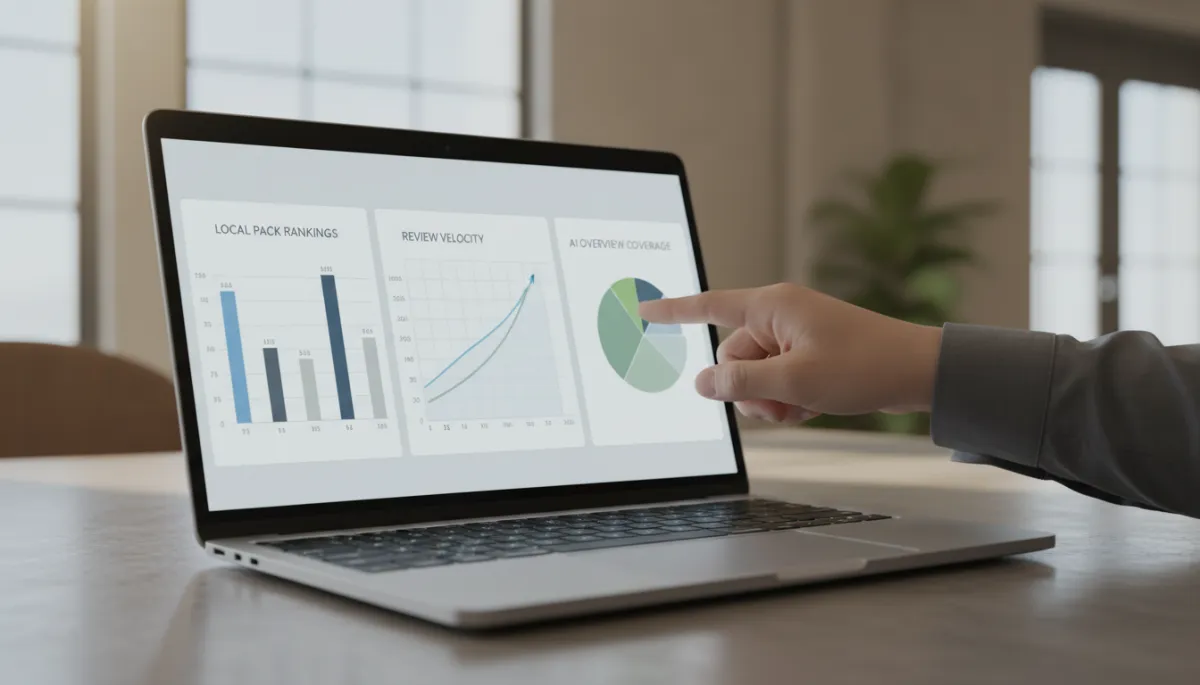
High‑performing teams treat Local SEO audits as recurring operating reviews, not marketing side projects.
The Local Visibility Operating System™ (LVOS)
To connect AEP, Trust Signal Infrastructure, and your 57‑point checklist, it helps to name the whole model. Think of your Local SEO program as a Local Visibility Operating System™ (LVOS)—a layered framework that turns fragmented tactics into an integrated, measurable system.
Entity Layer: NAP standards, categories, schema, and citations that tell search and AI systems exactly who you are and where you operate.
Trust Layer: Reviews, responses, ratings, and social proof that make you a safe recommendation for algorithms and humans alike.
Content Layer: Location pages, FAQs, and hyperlocal assets structured for Answer‑Economy Positioning (AEP) and “machine‑quotable” snippets.
Authority Layer: Local links, partnerships, press, and thought leadership that reinforce your expertise in each market.
Behavior Layer: Clicks, calls, direction requests, and branded search demand that signal real‑world relevance and preference.
Governance Layer: Ownership models, playbooks, and audit cadences that keep data clean and execution consistent across locations.
Measurement Layer: Dashboards, benchmarks, and executive reporting that translate LVOS performance into revenue and market‑share narratives.
LVOS Maturity Model: From Fragmented Tactics to AI‑Ready System
💡 Pro Tip: Map every item in your 57‑point checklist to one LVOS layer, then score each location from LVOS 1–5. This turns a long task list into a visual maturity model your team can benchmark, budget against, and improve quarter over quarter.
AEO + GEO Optimization: From Listings to Answer Surfaces
Traditional Local SEO asked: “How do we rank in the 3‑pack?” AEO + GEO strategy asks a sharper question: “When someone asks an AI assistant ‘Who is best near me?’, what evidence does the system see?” Your SEO strategy, content marketing, and social presence must converge into what we call a Trust Signal Infrastructure—a consistent web of structured data, reviews, citations, and expert content that answer engines can verify.
Use schema markup, FAQs, and clear headings to make pages “machine‑quotable.”
Build hyperlocal content—neighborhood guides, local case studies, and B2B use cases—to feed AI Overviews and external tools.
Leverage tools such as MagnoPro and AI‑ready content workflows from specialized content programs to scale structured, locally relevant assets.
Why Most Local SEO Audits Fail
Most Local SEO audits don’t fail because the checklist is wrong—they fail because the operating model around the checklist is missing. The result is a flurry of one‑time fixes with no durable lift in rankings, recommendations, or revenue.
Too tactical: Teams obsess over title tags and photos but never connect changes to market share, store‑level P&L, or LVOS layers.
No ownership: GBPs, reviews, and location pages sit in a gray zone between marketing, operations, and franchises—so nothing gets owned end‑to‑end.
No governance: There are no standards for categories, naming, or responses, so every location improvises its own version of the brand.
No executive reporting: Leadership sees Local SEO as “website stuff,” not as a revenue system, because dashboards stop at impressions and clicks.
No AI readiness: Facts conflict across GBP, site, and citations, so answer engines quietly avoid recommending the brand in AI Overviews and assistants.
No remediation process: Audits surface issues, but there is no prioritized backlog, no SLAs, and no cross‑functional process to fix what was found.
“An audit without governance is just an expensive screenshot of how you’re losing demand.”
Canadian Local SEO Challenges
Canadian organizations face all the usual Local SEO challenges—plus a uniquely Canadian layer of complexity. Winning in Toronto, Vancouver, Calgary, or Halifax is not the same as winning in mid‑sized or remote markets across the Prairies, Atlantic Canada, or the North.
Bilingual markets: Quebec and many federal‑facing sectors require French and English content, reviews, and schema. Dual‑language GBPs, location pages, and support workflows become non‑negotiable.
Provincial regulations: Healthcare, financial services, legal, and home services often face different rules by province, which affects what can be claimed in GBP descriptions, reviews, and local content.
Sparse geographic regions: In many parts of Canada, “near me” may cover a 50–100 km radius. GEO strategy must account for travel distance, service areas, and regional terminology, not just dense urban postcodes.
Multi‑location logistics: National and provincial brands must coordinate inventory, hours, and service availability across time zones, weather patterns, and seasonal demand spikes (e.g., winter tires, HVAC, tourism).
Regional search behaviour: Search language and expectations differ between major metros, resource‑based towns, and border communities influenced by US media and pricing. Your LVOS needs to reflect these nuances in content and offers.
📌 Canadian advantage: Brands that design Local SEO systems specifically for Canadian realities—rather than copy‑pasting US playbooks—can own high‑value niches with far less competition.
Risks & Governance: Where Local SEO Programs Fail
Most local programs fail not on tactics but on governance. Common failure patterns include:
Fragmented ownership: franchises, stores, and agencies editing GBPs without standards—leading to NAP drift and category chaos.
Compliance and data risk: unapproved photos, staff names, or sensitive information in reviews and Q&A; lack of policies for AI‑generated content.
AI trust gaps: inconsistent facts across site, GBP, and directories causing answer engines to ignore or down‑rank your brand.
Leading organizations formalize a Local SEO charter, often with support from a specialist local SEO partner or a broader digital consultancy, and run quarterly audits supported by dashboards or platforms, with leadership reviews similar to sales pipeline meetings.
FAQs: Executive‑Level Answers for Local SEO Audits
How often should we run a full Local SEO audit?
For multi‑location brands, quarterly is the minimum. High‑velocity categories (retail, hospitality, healthcare) benefit from monthly GBP and review checks, with a deeper 57‑point audit every quarter.
Where do we start if our GBPs are a mess?
Start with entity clarity: lock NAP standards, primary categories, and ownership rights. Then normalize data via a central system, and only then scale posts, photos, and Q&A. A focused strategy session can accelerate this reset.
How does Local SEO intersect with B2B SEO?
For B2B, local visibility often influences partner selection, field sales coverage, and trust in regional offices. Align your corporate B2B SEO strategy with localized proof—case studies, certifications, and sector‑specific landing pages.
Can AI tools replace manual Local SEO audits?
AI can surface gaps at scale—missing fields, inconsistent NAP, thin pages—but it cannot yet own governance, brand nuance, or local partnerships. Use platforms like MagnoPro demos as accelerators, not substitutes for accountable ownership.
What KPI should the executive team watch first?
Focus on a simple trio per location: Local Pack visibility, direction requests, and review velocity. Together, they indicate discoverability, intent, and trust.
Final Operating Model: From Checklist to Local Growth System
The leaders in Local SEO do three things differently: they treat their 57‑point checklist as a recurring operating ritual, they integrate Local SEO with broader growth systems, and they design for the Answer Economy, not just for blue links. In practice, that means:
Strategy: clear AEP and GEO objectives, tied to revenue and market share by region.
Systems: centralized data, standardized GBPs, integrated content and review workflows across marketing, operations, and customer service.
Cadence: quarterly audits, monthly optimizations, and continuous measurement, supported by expert partners in Local SEO and digital strategy.
In a world where AI systems increasingly decide which local businesses deserve attention, the organizations that operationalize Local SEO audits as a core business process—not as a campaign—will own the next decade of local demand.
References
[1] searchlab.nl – Local SEO Statistics 2026. [2] seoscaleup.com – Local SEO Trends & Statistics 2026. [3] flento.io – Local SEO Ranking Factors. [4] localmighty.com – Local SEO Ranking Factors. [5] mediasearchgroup.com – Local SEO Techniques. [6] buarich.com, listuro.com – Local SEO in 2026 and AI Search Trends.


