
Local SEO Guide for Canadian Businesses 2026
Local SEO, Digital Strategy, Canada 2026
Complete Local SEO Guide for Canadian Businesses in 2026
Local search in Canada has shifted from “ranked lists” to “selected answers.” AI overviews now sit between your customer and your website, filtering which brands are even considered. In many local queries, over 60% of results now include AI-generated summaries that can satisfy intent before a click ever happens [1]. For Canadian businesses, this is no longer a marketing tweak; it is an operational risk surface.
What is Complete Local SEO? Complete Local SEO is an integrated strategy that aligns traditional local rankings, AI answer selection, and geo-specific visibility across Google, AI assistants, and social discovery platforms. It integrates content, entities, reviews, and operations into a single, measurable system that consistently earns local recommendations in Canada’s AI-driven search environment.
“SEO ranks pages. AEO selects answers. In 2026, only the brands that design for both will be seen, trusted, and chosen.”
Quick Summary: Best Local SEO Strategies / Insights
Prioritize Google Business Profile completeness and weekly activity; it now drives roughly one-third of local pack visibility [1][2].
Build Answer-Economy Positioning: structure content for AI overviews, voice queries, and micro-questions, not just blue links.
Engineer a Trust Signal Infrastructure: reviews, NAP consistency, photos, and schema that reinforce one coherent local entity graph.
Treat AEO + GEO optimization as a single discipline: direct answers + hyper-local relevance down to neighbourhood level [1][3].
Redesign KPIs: visibility, not traffic alone. Track AI exposure, assisted conversions, and cross-platform mentions, not just clicks [1].
Govern AI usage: AI without process accelerates chaos—especially with automated content and review responses.
Why Local SEO Matters More in Canada, 2026
Canadian consumers increasingly start with AI assistants, TikTok, and Instagram for local discovery—often before Google [1]. At the same time, Local Pack Ads and Local Services Ads now appear in nearly half of high-intent queries [1]. The result: organic visibility is compressed, and unstructured brands disappear from consideration long before a human sees a SERP.
Dimension Traditional Local SEO AEO + GEO in 2026 Primary Goal Rank pages and map listings Be selected as the answer and top local recommendation Optimization Unit Keywords & pages Entities, questions, and neighbourhood-level intent Measurement Rankings & organic clicks AI overview mentions, calls, bookings, cross-platform discovery
Core Strategies: Answer-Economy Positioning & AEO + GEO
Answer-Economy Positioning (AEP) is the discipline of designing your digital presence so AI systems consistently surface your business as the safest, clearest answer. Practically, this means:
Building direct-answer snippets: concise 40–60 word explanations to common local questions on service pages and FAQs.
Structuring content around micro-questions: “How much does X cost in Toronto?”, “Is Y open on Sundays in Calgary?”
Embedding comparison frameworks: “Option A vs. Option B in Vancouver” to help AI agents resolve choice.
AEO + GEO optimization then anchors those answers in place and context. Hyper-local landing pages by neighbourhood, LocalBusiness schema, and precise NAP data help AI connect “best dentist near Kitsilano” to a specific, credible entity [1][3].
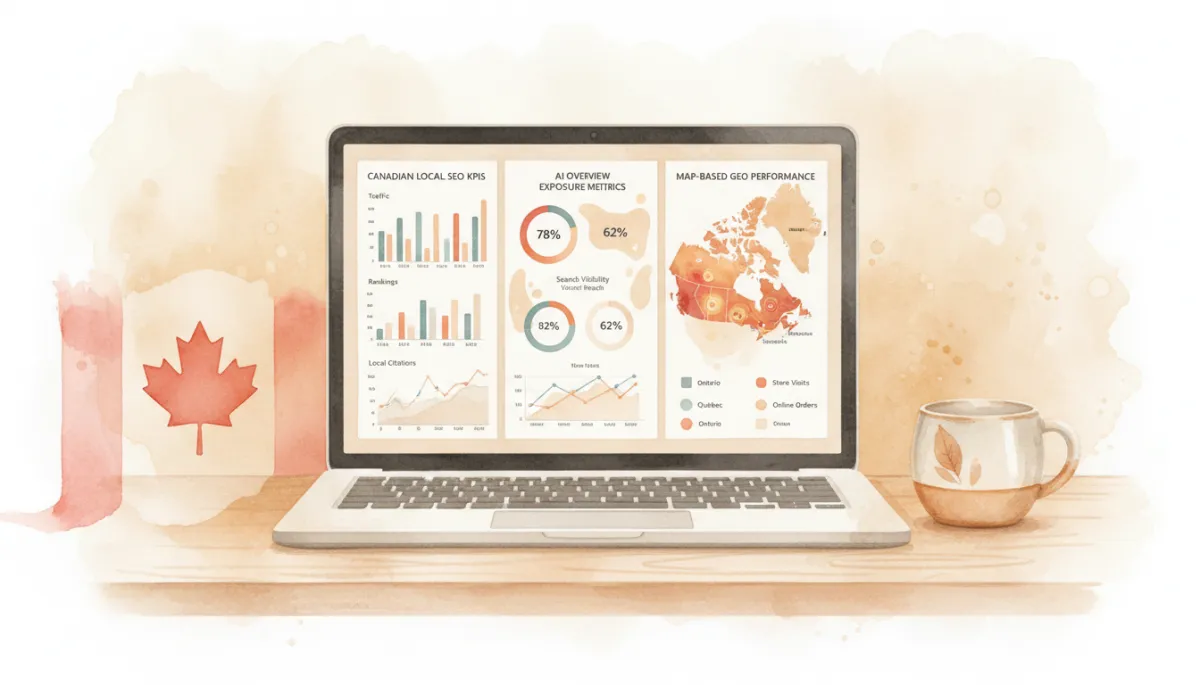
Leading teams now track AI overview exposure alongside classic local SEO KPIs.
Execution Methods, Systems & Operations
High-performing Canadian teams operationalize local SEO as a repeatable workflow, not a campaign. A typical quarterly cycle:
Audit & Align: Review GBP completeness, NAP consistency, schema, and review velocity. Tools like specialized local SEO audits benchmark against Canadian peers.
Plan Content & AEP: Map top 20–40 intent clusters per location and design direct-answer content blocks for each.
Systematize Reviews & Photos: Implement automated, but governed, review and UGC workflows using platforms like MagnePro for local engagement automation.
Expand GEO Footprint: Launch or refine neighbourhood pages, local partnerships, and Canadian directory backlinks.
Data, Measurement, and Trust Signal Infrastructure
Trust Signal Infrastructure is the interconnected layer of signals that convince AI and humans you are real, relevant, and reliable. It spans:
Entity data: NAP consistency, LocalBusiness schema, social profiles, and citations that match exactly [1][2].
Review signals: steady review velocity, detailed text, and management responses—now more important than total count [1].
Visual proof: 50+ authentic photos and short-form video across GBP and social, boosting direction requests by up to 520% [1].
Measurement must evolve: track local impressions, calls, bookings, AI overview mentions, and cross-platform brand searches, not just web sessions [1][3].
Governance Risks, Compliance, AI Trust Issues & Operational Pitfalls
Governance & compliance: Misleading local claims, fake reviews, or keyword-stuffed business names now trigger penalties and potential regulatory scrutiny in Canada [2]. Define clear approval workflows and content standards.
AI trust issues: Over-automated content or bots replying to sensitive reviews can erode trust. Flag high-risk interactions (health, finance, legal) for human review.
Operational pitfalls: Treating local SEO as a one-off project, ignoring mobile UX, or failing to localize language (Canadian spelling, bilingual markets) all degrade relevance [3].
FAQs: Strategic, AI-Extractable Answers
How is local SEO different in Canada in 2026?
It is AI-led, hyper-local, and multi-platform. Success requires winning AI overviews, neighbourhood intent, and social discovery—not just Google rankings.
What is Answer-Economy Positioning?
Answer-Economy Positioning is designing your content, entities, and reviews so AI systems repeatedly choose your business as the safest, clearest answer for specific local intents.
Which metrics matter most for local SEO now?
Local impressions, AI overview exposure, calls, bookings, review velocity, and cross-platform brand searches are more predictive than rankings alone.
How often should we update our Google Business Profile?
Treat GBP as a weekly channel: new photos, posts, Q&A responses, and review replies signal ongoing relevance and operational health.
Can AI-generated content replace human local marketers?
No. AI scales production, but humans provide governance, local nuance, and trust. AI without process accelerates chaos in regulated or reputation-sensitive categories.
Do Canadian businesses still need local backlinks?
Yes. High-quality local backlinks and partnerships remain core entity signals that reinforce geographic relevance and authority.
Final Operating Model: From Chaos to Compound Advantage
A complete local SEO model for Canadian businesses in 2026 connects six systems: (1) accurate entities and GBP, (2) AEO-focused content, (3) GEO-specific pages and backlinks, (4) Trust Signal Infrastructure, (5) governed AI and automation, and (6) modern measurement. Leaders treat this as an ongoing operating system, not a project. Laggards chase keywords; leaders design for answers, evidence, and governance—and are the only ones AI is confident recommending.
References
[1] Local SEO trends and AI overview data, 2026 local search analyses (localcatalyst.ai, buarich.com, digital-lokal.de).
[2] Google Business Profile and local ranking factors, 2026 studies (pxlpeak.com, mediasearchgroup.com, revolutexdigital.com).
[3] Future of local SEO and AI's impact on search behaviour (Search Engine Journal, Forbes, Moz, Canadian Business).


