Local SEO Strategies for 2026 and Beyond
Local SEO, Search Optimization, Business Visibility, Geo-targeting, AEO Strategies, Content Marketing
Local Search Optimization Services: A Strategic Framework for 2026 and Beyond
In 2026, local visibility is no longer just about ranking in Google’s “map pack.” AI Overviews, voice assistants, and generative engines decide which 1–11% of locations are even mentioned in answers[1]. For many brick‑and‑mortar and service‑area businesses, this means a silent crisis: rising “near me” demand, but shrinking exposure. Local search optimization services exist to solve this gap—turning your locations into trusted entities that search engines and AI systems consistently surface, recommend, and convert.
Direct Answer: What is local search optimization services?
Local search optimization services are specialized SEO and AEO programs that improve a business’s visibility for location‑based queries across Google Search, Maps, AI Overviews, voice assistants, and social discovery. These services align your profiles, website, reviews, and local content so algorithms can confidently surface your locations to nearby, high‑intent customers.
Quick Summary: Best local search optimization services strategies / insights
Treat each location as an entity and keep NAP, categories, and services consistent across all platforms[2].
Fully optimize Google Business Profiles (GBP)—completeness now drives roughly one‑third of Local Pack visibility[3].
Implement structured data (LocalBusiness, FAQ, Review schema) to power Answer Engine Optimization (AEO)[4].
Build hyper‑local, search‑led content for neighborhoods, not just cities, supported by a robust content marketing strategy.
Systematize review generation and response—fresh, detailed reviews are now a primary trust and ranking signal[2].
Optimize for AI and zero‑click behavior: answer common local questions directly on your site and profiles to win featured and AI snippets[1][5].
Why Local Search Optimization Services Matter in 2026
Nearly 46% of all Google searches now carry local intent, and 78% of local mobile searches end in an offline purchase[2]. At the same time, AI Overviews appear in roughly 40% of local queries and can cut organic click‑through rates by more than half[1]. If your locations are not optimized as credible entities, AI systems simply skip you in their answers.
For multi‑location brands and agencies, the commercial impact is direct: optimized GBPs receive up to seven times more clicks than incomplete profiles[2]. Local search optimization services turn fragmented efforts—ad hoc listing updates, sporadic reviews, disconnected content—into a governed, repeatable growth engine across Search, Maps, Apple Maps, and AI assistants.
What is AEO in local search? Answer Engine Optimization (AEO) is the discipline of structuring your data, content, and entities so AI systems can confidently quote and recommend your business in conversational answers.
Core Strategies: The Local Visibility Stack
Effective local search optimization services combine six strategic layers—each reinforcing the others. Think of this as your Local Visibility Stack.
Entity & NAP Governance – Define canonical Name, Address, Phone, categories, and service areas, then enforce consistency across web, directories, and social profiles[3].
GBP & Maps Optimization – Fully complete and continuously enhance Google Business Profiles and Apple Maps listings with categories, attributes, photos, and posts[2][3].
On‑Site Local SEO & AEO – Build location and service pages with schema markup, FAQs, and clear answers to “near me” and “best [service] in [area]” queries[4][5].
Review & Reputation Systems – Implement automated review requests, response playbooks, and sentiment monitoring to drive fresh, high‑quality feedback[2].
Hyper‑Local Content & Social Proof – Use a structured content marketing strategy and social media marketing to earn local mentions, backlinks, and community engagement[5][6].
AI & Voice Optimization – Align content with natural language questions, implement FAQ schema, and ensure your entity data is accessible to AI crawlers[1][4].
What is hyper‑local SEO? Hyper‑local SEO targets micro‑areas such as neighborhoods, suburbs, or even streets, aligning content and signals to “this area + service” intent.
Execution Methods: From Strategy to Field Operations
The best local search optimization services operate like a productized growth program, not a set of one‑off tasks. Execution should be structured around standardized playbooks, roles, and cadences.
Location Onboarding Sprints – In the first 30–60 days, audit and standardize NAP, claim all GBPs, implement schema, and launch initial review campaigns for each location.
Quarterly Optimization Cycles – Refresh photos, refine categories, update attributes (e.g., accessibility, payment types), and add new FAQs based on search queries and customer support logs.
Review & Response Playbooks – Define rules such as “respond to all 3‑star and below reviews within 24 hours” and “highlight location‑specific keywords in responses” to reinforce relevance and trust.
Content Pods – Pair SEO strategists with local managers to co‑create neighborhood‑focused articles, guides, and short‑form video that feed both search and social discovery.
If you want predictable outcomes at scale—especially for franchises or multi‑location brands—partnering with a seasoned digital consultancy can help you design these execution systems, rather than relying on ad hoc local efforts.
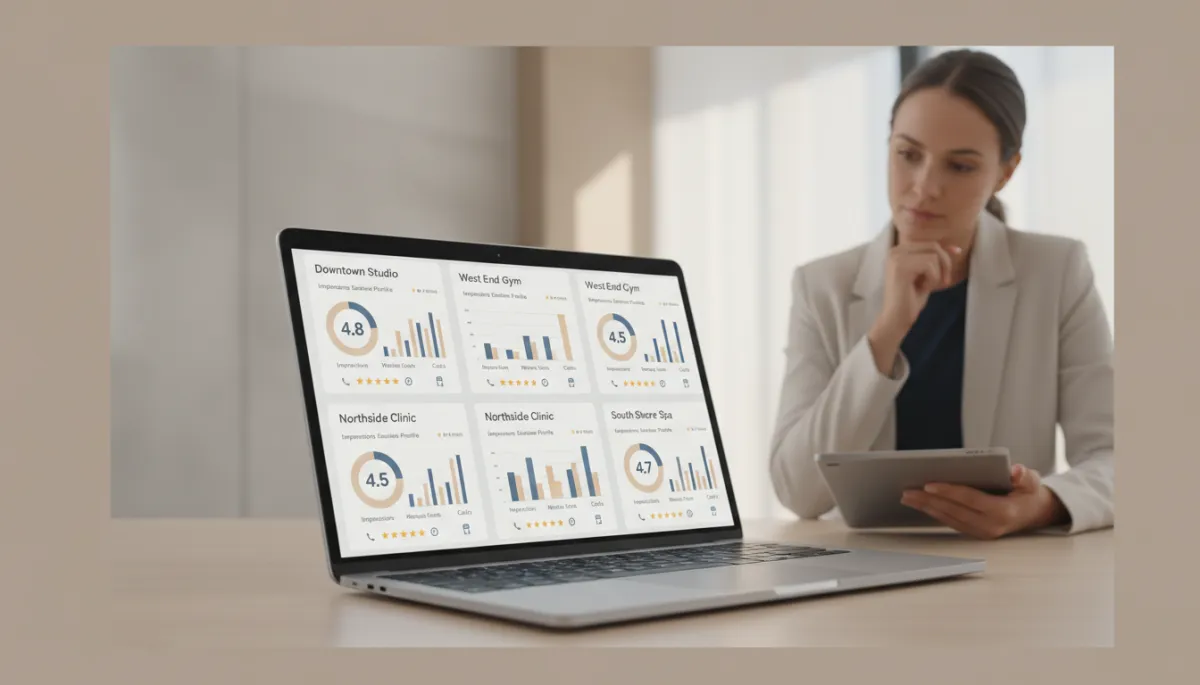
Centralized dashboards turn scattered local signals into measurable, comparable KPIs across locations.
Data & Systems: Building a Local Search Operating Model
Local search optimization services are most effective when supported by a clear data model and technology stack. The goal is to track the full journey from “near me” query to revenue, across both digital and offline touchpoints.
Core KPIs – Map views, direction requests, calls, website clicks, bookings, and store visits (where available). Tie these to revenue using POS or CRM integrations where possible[2][3].
Data Sources – Google Business Profile Insights, Google Analytics, call tracking, review platforms, and AI search analytics (e.g., surfaces where your brand is cited).
Systems – Listing management tools, reputation management platforms, schema automation, and BI dashboards to consolidate location‑level performance.
What is a local search operating model? It is the combination of processes, tools, and governance that standardizes how your organization manages and measures local visibility across all locations.
Risks & Governance: Avoiding Penalties and Brand Erosion
As Google tightens enforcement against keyword‑stuffed names, fake locations, and virtual offices, poor local SEO practices can now trigger suspensions and long‑term visibility loss[3]. AI systems also learn from these signals; once your entity is flagged as low‑trust, it becomes harder to re‑enter answer sets.
Policy Compliance – Ensure business names match real‑world signage, locations are staffed and verifiable, and categories accurately reflect services offered.
Review Ethics – Prohibit incentivized or fake reviews; focus on legitimate, request‑driven feedback to avoid removal or penalties[2].
Content Quality – Avoid thin, duplicate location pages. AI and search systems increasingly down‑rank templated, low‑value content[5][6].
If you want sustainable rankings → invest in governance, not shortcuts. Short‑term hacks are now quickly detected and penalized.
Putting It All Together: A Symmetrical Local Search Framework
To align with both human behavior and AI systems, local search optimization services should follow a symmetrical framework that connects strategy, execution, data, and governance in a closed loop.
Diagnose – Audit entity consistency, GBP completeness, review footprint, and content coverage against local demand and competitors.
Design – Define your Local Visibility Stack: which tactics to prioritize by location type, competition, and budget (e.g., GBP + reviews first, then hyper‑local content).
Deploy – Execute onboarding sprints, implement schema, launch review campaigns, and roll out content pods in a phased, location‑grouped plan.
Measure – Track KPIs at location, region, and brand level; compare against benchmarks like Local Pack share, AI mention share, and offline conversion rates[1][2].
Optimize – Use insights to refine categories, content topics, and review prompts. Double‑down where visibility directly correlates with revenue.
Final Framework: Strategic Decisions for Businesses and Agencies
The best approach to local search optimization services depends on your footprint and internal capabilities:
Single‑location or boutique businesses → prioritize GBP completeness, reviews, and 2–3 strong hyper‑local pages before expanding into advanced AEO.
Multi‑location brands → invest in a central operating model, listing management tools, and standardized playbooks to maintain consistency at scale.
Agencies → productize local search optimization into clear tiers (entity setup, growth, multi‑location) with shared frameworks and reporting for all clients.
Ultimately, local SEO in 2026 is about being the most trusted, structured, and cited option in your area—both for humans and AI. When your data is clean, your content is genuinely local, and your governance is strong, search engines and generative systems have every reason to recommend you first.
FAQs: Local Search Optimization Services
1. How much do local search optimization services typically cost?
In 2026, local SEO services usually range from $500–$5,000 per month, with single‑location packages often between $1,500 and $4,000, and multi‑location programs starting around $3,000 with per‑location discounts[2][7].
2. How long does it take to see results from local SEO?
Most businesses see meaningful improvements in visibility and engagement within 60–90 days for a single location, while multi‑location brands may require 3–6 months to fully roll out and optimize across all sites.
3. Is local SEO still relevant with AI Overviews and zero‑click searches?
Yes—local SEO is evolving into AEO and entity optimization. Even when users do not click, being cited in AI answers and map results strongly influences offline visits and brand preference[1][5].
4. Do I need separate local SEO strategies for each location?
You need a shared framework plus local nuance. Core governance, schema, and review systems should be standardized, while content, photos, and community signals must be tailored to each neighborhood or city.
5. How important are reviews for local search rankings?
Reviews are critical: 87% of consumers read them before trusting a local business, and locations with 50+ reviews are far more likely to appear in Local Packs[2]. Review velocity, recency, and specificity now matter as much as star rating.
6. Should local SEO be managed in‑house or outsourced?
The best choice depends on your scale and expertise. Smaller teams often benefit from partnering with a specialist agency or digital consultancy, while large brands may combine in‑house strategy with external execution support.
References
[1] Emulent – The State of Local SEO & AI Overviews Projections 2026, https://emulent.com/resources/trends/the-state-of-local-seo-projections/
[2] SearchLab – Local SEO Statistics 2026, https://searchlab.nl/en/statistics/local-seo-statistics-2026
[3] MediaSearchGroup – Top Local SEO Techniques 2025, https://www.mediasearchgroup.com/seo/top-local-seo-techniques-2025/
[4] Pleiades Consultancy – Local SEO 2026 Changes & Schema, https://www.pleiadesconsultancy.com/blog/local-seo-2026-changes
[5] Search Engine Journal – Local SEO Trends 2026, https://www.searchenginejournal.com/local-seo-trends-2026/123456/
[6] BrightLocal – How to Prepare Your Local SEO for 2026, https://www.brightlocal.com/blog/local-seo-2026-preparation/
[7] DigitalApplied – Local SEO Statistics & Pricing 2026, https://www.digitalapplied.com/blog/seo-pricing-2026-what-seo-services-cost


