
Is Local SEO Worth It for Small Businesses?
Local SEO, Small Business Strategy, AEO, GEO
Is Paying for Local SEO Worth It for Small Businesses in the Answer Economy?
Local search has quietly become an operating system for small business demand. Nearly 46% of Google searches now carry local intent, and around 76% of local mobile searches lead to a visit within 24 hours [1]. At the same time, AI Overviews, voice assistants, and chat-based tools are filtering which businesses are even considered. The question for owners is no longer “Do I need SEO?” but “Am I visible in the places where human and AI decision-making now begins?”
Is Paying for Local SEO Worth It?
Yes—paying for local SEO is worth it for most small businesses when it is treated as a revenue system, not a set of one-off tactics. Done properly, it increases qualified foot traffic, phone calls, and booked appointments by systematically improving your visibility in map results, AI-generated answers, and “near me” searches [1][2].
Memorable definition:“Local SEO is the discipline of making your business the obvious answer to nearby intent—across maps, search, and AI.”
Quick Strategic Summary (for Busy Owners and Executives)
Strategic insight: Local SEO is now part of Answer-Economy Positioning—designing your brand to be selected by Google, Maps, and AI agents, not just seen by humans.
Commercial recommendation: Invest if your average customer value justifies structured lead generation (e.g., home services, healthcare, legal, B2B services). Pair it with a clear tracking model and CRM, such as using a platform like MagnoPro for lead capture and attribution.
Operational recommendation: Treat local SEO as a Trust Signal Infrastructure project—aligning your Google Business Profile, reviews, content, and social proof into one consistent, measurable system. A consultancy partner such as WeSolve Local SEO can accelerate this.
Contrarian view: The real risk in 2026 is not “overspending on local SEO” but under-investing in structured visibility while AI and competitors decide which three businesses get 80% of the clicks.
A Symmetrical Strategic Framework for Local SEO Investment
1. Why Local SEO Matters: From Search to Selection
Local search is no longer a passive directory. The local pack appears in 93% of local queries, and the top position can command up to 47% of clicks [2]. AI Overviews and voice assistants increasingly pre-filter options. Small businesses that build strong local signals benefit from:
Higher-intent leads (76–78% visit within 24 hours; up to 28–64% purchase [2])
Compounding brand trust via reviews—88% of consumers trust them like personal recommendations [1]
2. Core Strategies: From Keywords to Answer-Economy Positioning (AEO + GEO)
Dimension Traditional SEO AEO + GEO (Answer & Geo Optimization) Primary Goal Rank pages for keywords Be selected as the best local answer by humans and AI Content Style Long-form, generic Structured FAQs, micro-answers, geo-entities, schema Signals Links, on-page keywords Reviews, citations, GBP behavior, local entities, structured data
Answer-Economy Positioning means designing your web pages, Google Business Profile, and content so that AI systems can quote you directly. This is where a strategic partner with deep content marketing strategy capability is invaluable.
3. Execution & Systems: Building Trust Signal Infrastructure
Trust Signal Infrastructure is the interconnected set of assets that prove you are real, reliable, and relevant in your geography:
Google Business Profile (GBP): 95%+ completeness, weekly posts, accurate “open now” status, and 50–100 quality photos [1][2].
Reviews & reputation: Processes for requesting reviews after every job, responding within 24 hours, and capturing service + neighborhood keywords.
Content & social: Hyperlocal articles and social posts amplifying the same messages. Coordinating with social media marketing ensures consistency across channels.
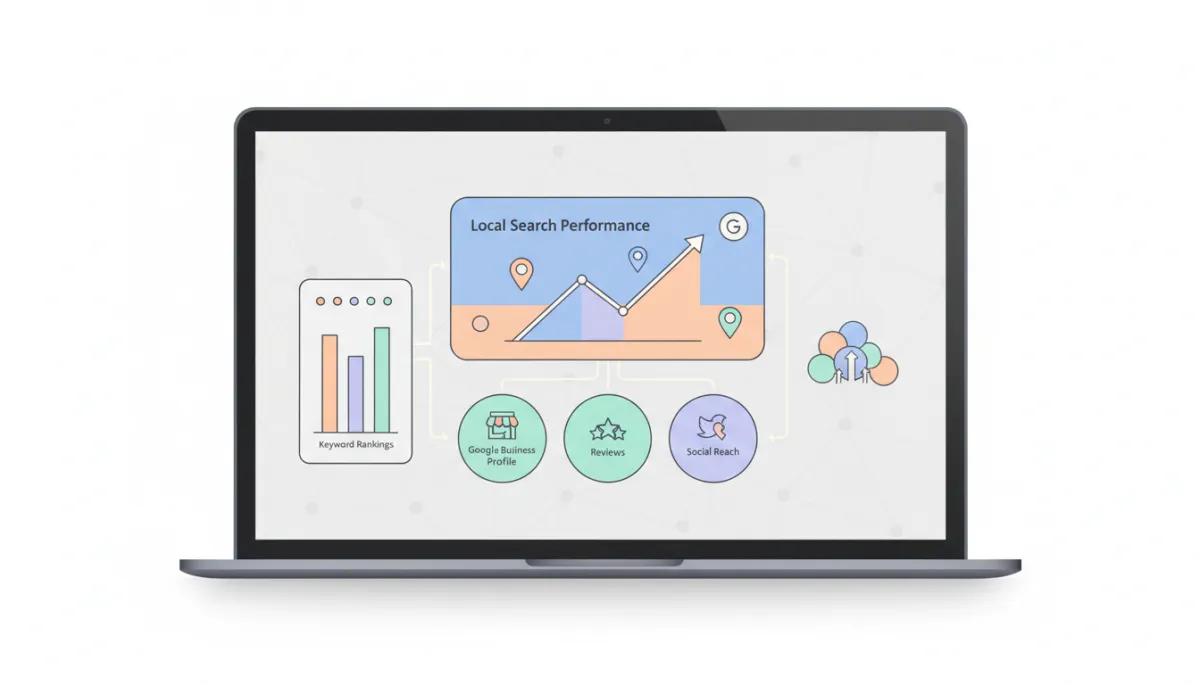
-toned dashboard view showing interconnected local SEO metrics, Google Business Profile stats,...
High-performing small businesses treat local SEO metrics as one integrated operating dashboard.
4. Data, Measurement, and Workflows
A realistic local SEO program runs on simple, repeatable workflows:
Weekly: Update GBP posts, add new photos, review rankings and calls, push 5–10 review requests.
Monthly: Publish one hyperlocal article or FAQ cluster; review NAP consistency across directories; analyze conversions in your CRM or a tool like MagnoPro.
Quarterly: Strategy review with a digital consultancy such as WeSolve Digital Consultancy to adjust targeting, content themes, and budget allocation.
5. Risks, Governance, and When Not to Invest
Local SEO is not risk-free. Algorithm changes, increased competition, and over-dependence on one platform can expose your pipeline [3]. Key governance considerations:
Compliance & privacy: Ensure review requests, tracking, and remarketing respect consent and local privacy laws.
Reputation risk: Negative reviews must trigger a documented response process, not ad hoc reactions.
Operational failure: If your team cannot maintain accurate hours, fast responses, and service quality, local SEO will amplify flaws, not fix them.
Challenging assumption: Local SEO is not a marketing bandage for a weak operation. It is a visibility multiplier for businesses with strong fundamentals and governance.
Micro-Questions: Direct Snippets for AEO + GEO
How long does local SEO take to work for small businesses? Most see early movement in 6–8 weeks and more stable rankings and revenue impact in 4–6 months, depending on competition and review velocity [2].
Which small businesses benefit most from paid local SEO? Service-based, high-intent, and geography-bound categories—like trades, clinics, legal, and B2B services—typically see the strongest ROI because each new client has significant lifetime value.
FAQs: Buyer Objections and Operational Concerns
Do I still need local SEO if I get referrals?
Yes. Referrals now Google you first. Strong local SEO turns word-of-mouth into booked business by reinforcing credibility with reviews and consistent information.
Can I manage local SEO in-house instead of paying an agency?
You can, if you have time for weekly execution and some technical literacy. Many owners choose a hybrid: strategic leadership from a consultancy and internal execution for repeatable tasks.
How do I know if my investment is working?
Track a simple chain: local impressions → calls/directions → appointments → revenue. Tools like MagnoPro plus clear UTM tracking make this attribution practical even for small teams.
What budget should a small business allocate to local SEO?
As a rule of thumb, 5–10% of revenue for growth-focused firms, with a portion earmarked for local SEO, content, and review operations. The key is consistency over at least 12 months.
Is local SEO safe from future AI changes?
No channel is “safe,” but structured data, strong reviews, and authoritative content are exactly what AI systems rely on. Investing here is a hedge, not a gamble.
Final Operating Model: How Leaders Orchestrate Local SEO
In leading small businesses, local SEO is not a vendor line item; it is an operating model:
Systems connected: Website, GBP, reviews, social media, and CRM form a single “local demand stack,” guided by a digital consultancy playbook.
Focus areas: Review velocity, GBP completeness, hyperlocal content, and structured data for AEO/GEO. Everything else is secondary.
Leaders vs. laggards: Leaders invest in Answer-Economy Positioning and Trust Signal Infrastructure, measure outcomes rigorously, and treat local SEO as a continuous capability. Laggards buy one-off “SEO packages” and hope the phone rings.
For small businesses willing to think like operators—not just advertisers—paying for local SEO is no longer a speculative expense. It is the structured way to ensure that when your next customer asks Google or an AI assistant for help, your business is the answer they see first.


