Build a Predictable Lead Generation System
Lead Generation, Lead Management, Marketing Automation, Business Growth
Predictable Leads Come From a Repeatable System—not Random Campaigns.
A predictable pipeline is not about knowing exactly how many leads will arrive next month. It is about building a connected, repeatable process for attracting prospects, capturing inquiries, responding quickly, following up consistently, and measuring what ultimately becomes revenue. Without that system, lead generation rises and falls with individual campaigns, referrals, seasonal demand, and the amount of attention the business gives to marketing that month. A predictable system cannot eliminate market changes. It gives the business enough visibility and consistency to understand what is working, identify breakdowns, and deliberately improve performance.
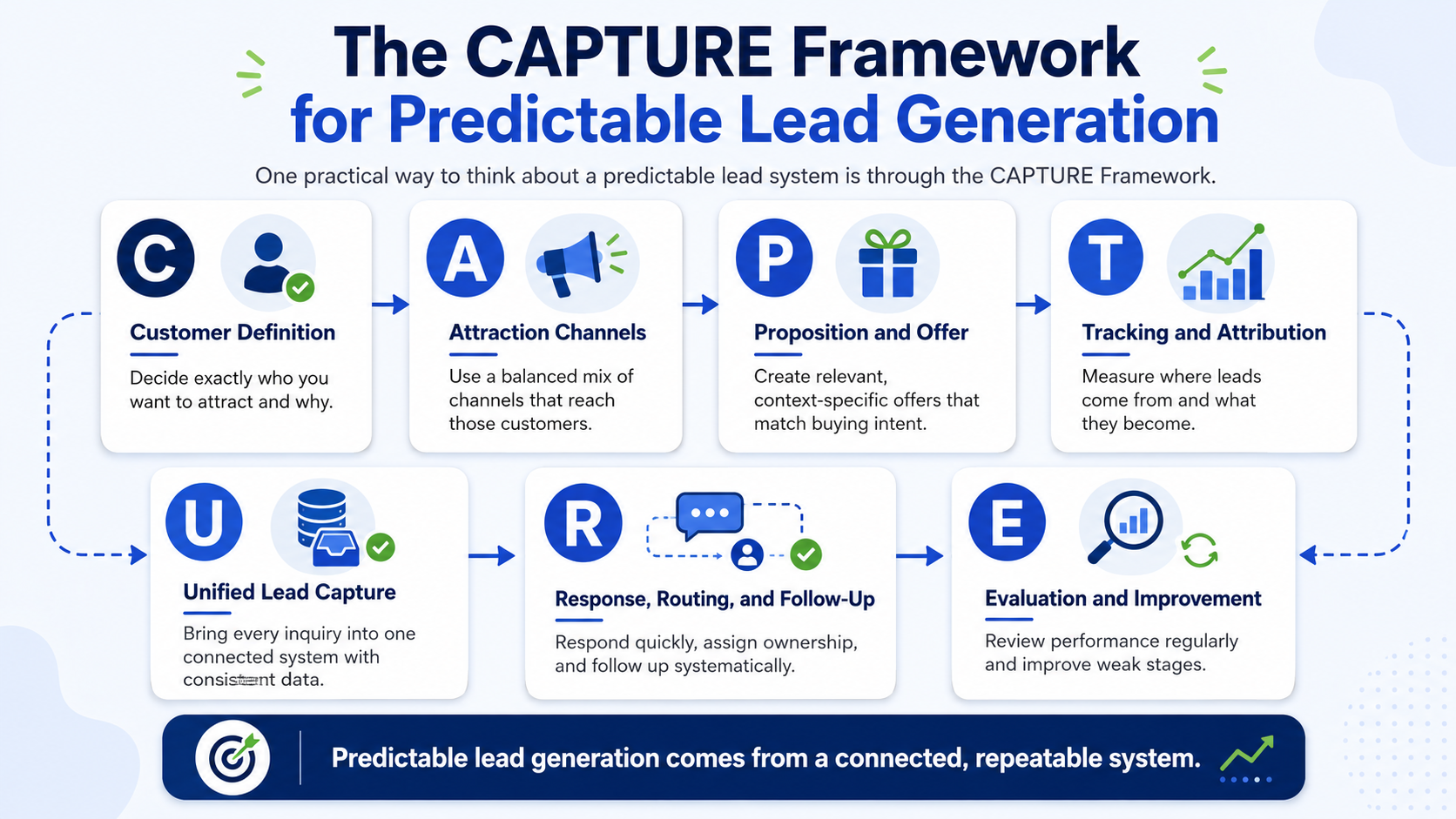
C — Start by Clearly Defining Your Target Customer
Every predictable lead system starts with clarity. Who are you actually trying to attract? For small and medium-sized Canadian businesses, that might mean narrowing by industry, geography, budget, or problem. Go beyond basic demographics and capture:
The key problems they’re trying to solve right now
How they research solutions and make decisions
What “success” looks like from their point of view
Store the agreed customer criteria in the CRM using fields, tags, segmentation rules, and qualification forms. This helps marketing and sales apply the same definition consistently. If you need help defining personas and messaging, a tailored content marketing strategy can ensure your content speaks to the right prospects at each stage.
A — Choose Balanced Lead Attraction Channels
Relying on a single lead source is risky. A balanced attraction mix spreads your bets across channels that fit your buyers and your budget. This might include:
Search (Google Ads, SEO) for high-intent prospects
Social ads and content for awareness and retargeting
Referrals, partnerships, and events for warm introductions
A predictable system doesn’t chase every shiny tactic. It focuses on a few channels, tests them, and doubles down on what reliably produces quality leads. To strengthen your presence where your audience spends time, consider pairing your CRM with a focused social media marketing program that drives consistent traffic into your funnel.
P — Craft Relevant, Context-Specific Offers
People don’t wake up wanting a “discovery call.” They want solutions. Your offers should match where they are in their journey:
Early-stage: guides, checklists, and webinars that educate
Mid-stage: case studies, calculators, and audits that prove value
Late-stage: consultations, demos, and trials that reduce risk
In a connected system, you can link each offer to a specific landing page, form, and follow-up sequence, so every click flows into a clear next step. You can even plug in ready-made assets from tools like AI-powered short-form video creators or YouTube optimization platforms to drive more qualified visitors into those offers.
T — Put Tracking and Attribution at the Core
You can’t manage what you can’t see. Predictable lead generation depends on tracking:
Where leads came from (channel and campaign)
Which offers and pages they engaged with
How many become opportunities, customers, and repeat buyers
When attribution and opportunity tracking are configured correctly, your CRM can help connect lead sources and campaigns with appointments, sales outcomes, and recorded revenue.

Clear attribution reveals which channels and offers truly drive revenue growth.
U — Use Unified Lead Capture Across All Touchpoints
Scattered forms, inboxes, and spreadsheets are where good leads go to die. A predictable system captures every inquiry — web forms, landing pages, chat, phone, social — into one CRM, with consistent fields and tags.
A centralized setup helps ensure fewer leads are lost, duplicated, or forgotten, and your team can work from a single, accurate source of truth.
R — Automate Response and Follow-Up (Without Losing the Human Touch)
Speed matters. The sooner you respond, the more likely you are to convert. A strong lead system combines:
Instant confirmations and nurture emails or SMS messages
Task reminders for sales reps to call or follow up personally
Multi-step sequences that educate, build trust, and invite next steps
Automated confirmations, missed-call responses, and follow-up workflows can acknowledge inquiries outside normal business hours while ensuring important conversations are routed to the team.
Define Pipeline Stages That Reflect Reality
Predictability comes from knowing where every lead stands. That requires clear, agreed-upon pipeline stages such as:
New lead → Qualified → Meeting booked → Proposal sent → Won/Lost
In a visual pipeline, these stages are customizable, so your team can move deals forward consistently and your reports tell a true story about conversion rates and bottlenecks.
E — Build an Operating Rhythm Around Evaluation and Improvement
A system only becomes predictable when it’s reviewed regularly. That means setting an operating rhythm — weekly, monthly, and quarterly routines where you:
Evaluate channel performance, offer conversion, and follow-up completion
Identify leaks in the funnel and stuck deals in the pipeline
Decide small experiments to run before the next review
Properly configured dashboards and reporting can help teams review lead volume, pipeline movement, sales outcomes, and campaign performance consistently, so evaluation becomes a habit, not an afterthought.
A Realistic Example
Consider a Calgary commercial HVAC company receiving inquiries through Google Ads, organic search, referrals, and phone calls. Website forms are delivered to a shared inbox. Missed calls are recorded manually. Referral leads remain with individual salespeople. Follow-up depends on who notices each inquiry first.
The owner knows the business receives leads, but cannot reliably identify:
Which sources produce commercial contracts
How quickly prospects are contacted
How many inquiries book appointments
Why are estimates lost
Which campaigns create revenue
The company centralizes inquiries in a single CRM, records the source and service type, automatically assigns commercial opportunities, creates follow-up tasks, and tracks each lead through consistent pipeline stages. Emergency inquiries, maintenance prospects, and long-term replacement projects are placed into different follow-up paths.
Lead volume may not change immediately. But the business gains visibility into how opportunities enter, progress, convert, and become lost. That visibility creates the foundation for more predictable marketing decisions.
Predictability Comes From Visibility, Consistency, and Feedback
Markets change, customer behaviour shifts, and acquisition costs move over time. A predictable system does not eliminate those variables. It gives the business:
Visibility into where opportunities are coming from
Consistency in how inquiries are handled
Feedback about where prospects stop progressing
Historical information that supports better forecasting
A process for testing and improving performance
Predictability is therefore not certainty. It is the ability to understand results, respond to change, and improve the system before pipeline problems become business emergencies. Local businesses can reinforce this by using frameworks like the Local Visibility Operating System, which ties your lead flow to ongoing reputation, SEO, and listing improvements.
📌 Key Takeaway: Predictable growth isn’t about a perfect funnel. It’s about a living system you can see, run consistently, and refine over time.
LeadMagno’s Perspective on Implementing a Predictable Lead System
LeadMagno was built to support this CAPTURE-style approach for Canadian businesses by bringing lead generation, lead management, and marketing automation into one connected environment. In practice, that can include:
Defining customer segments using custom fields, tags, and qualification forms
Connecting forms, chat, calls, and campaigns into a unified lead inbox
Using workflows to send confirmations, create tasks, and route leads automatically
Tracking opportunities across standardized pipeline stages for clearer forecasting
Reviewing reports that connect campaigns and channels with booked appointments and closed revenue
When attribution, pipelines, and automations are configured thoughtfully, LeadMagno can help teams reduce duplicate records, missed conversations, and forgotten follow-ups, while making performance easier to understand and improve over time.
Turn Your Lead Process into a Growth Engine with LeadMagno
Build a Lead System Your Business Can Actually Manage
More campaigns cannot create stability when inquiries are scattered, ownership is unclear, and follow-up depends on memory. LeadMagno helps businesses connect lead capture, conversations, automated follow-up, appointment booking, pipeline management, and performance tracking within one system.
Book a free LeadMagno demo to see how a connected lead-management system can help your business create a more consistent and measurable path from inquiry to customer. When you’re ready to implement, you can schedule your LeadMagno demo and map out the exact workflows your business needs.


