
SEO vs Local SEO vs AI Search: What to Prioritize
SEO vs Local SEO vs AI Search: What Should Your Business Prioritize?
Canadian businesses are being told they need traditional SEO, Local SEO, AI search optimization, structured content, and stronger online authority. These are often presented as competing strategies, but they are better understood as connected layers of search visibility.
The right priority depends on where your customers search, what information they need, and how your business generates revenue.
Direct Answer
Every business needs a sound SEO foundation. Businesses serving a defined city or service area should prioritize Local SEO. Businesses that depend on educational, comparison, or research-driven searches should also make their content easy for AI-assisted search systems to understand and reference.
For most businesses, the answer is not to choose only one approach. It is to apply traditional SEO, Local SEO, and AI search optimization in the right order.
Quick Summary
SEO Is the Foundation
Traditional SEO improves your website’s technical performance, content relevance, usability, and authority.Local SEO Captures Nearby Demand
Local SEO helps businesses appear in local results, Google Maps, calls, directions, and appointment-based searches.AI Search Builds on SEO
Clear, original, well-supported information is easier for AI-assisted search systems to understand, summarize, and reference.Your Priority Depends on Your Customers
Local service businesses should normally emphasize Local SEO, while regional and national businesses may place greater weight on traditional SEO and informational content.Measure Business Results
Track qualified inquiries, appointments, customers, revenue, and profitability—not rankings alone.
Not Sure What Is Limiting Your Search Visibility?
Your business may not need more marketing activity. It may need a clearer understanding of where visibility is being lost.
Get an Organic Growth Audit to identify whether your biggest opportunity is traditional SEO, Local SEO, content quality, website performance, or AI search readiness.
Get Your Organic Growth Audit

What Is Traditional SEO?
Traditional SEO helps search engines crawl, index, understand, and surface website pages for relevant searches. It includes technical accessibility, clear website structure, useful service and product pages, internal linking, search-intent alignment, content quality, authority, and conversion tracking. For more details, see the official Google SEO fundamentals and how a strong SEO foundation fits into We Solve Digital’s SEO services.
Traditional SEO can support local, national, or international visibility. It also provides the website foundation that Local SEO and AI-assisted discovery depend on, including content that can support a broader content marketing strategy and other digital channels.
What Is Local SEO?
Local SEO is the process of improving a business’s visibility for searches connected to a specific city, neighborhood, service area, or nearby need.
When you compete in local search, Google’s systems look at a combination of relevance, distance, and prominence to decide which businesses to surface for nearby customers. Understanding these concepts helps you make more informed marketing decisions, even though Google does not publish the complete weighting of its local ranking systems. You can learn more from Google’s official local ranking guidance and consider how this fits into your broader local search strategy with a partner like We Solve Digital.
Relevance describes how well your business profile, website content, and overall presence match what someone is searching for. Clear service descriptions, accurate categories, and helpful content all support relevance.
Distance refers to how close your business is to the person searching or to the location mentioned in their query. You cannot control where people search from, but you can make sure your address and service areas are accurate.
Prominence reflects how well-known and established your business appears, both online and offline. This can include reviews, local mentions, and other signals that show your business is active and trusted within your community.
These factors work together with many other signals. No single element — including structured data, hosting location, or review count — guarantees visibility in local results or AI-assisted experiences. A focused Local SEO and search optimization plan should consider all of these elements together rather than chasing a single metric.
Clarifying AI Search Optimization for Canadian Businesses
AI search optimization (sometimes called SEO for AI-assisted search) is an industry term, not an official Google ranking system. It describes strategies that help your content be more easily understood, retrieved, and referenced by AI-assisted search experiences and tools such as AI overviews and conversational search. It does not replace traditional SEO, nor does it introduce a separate, published “AI ranking” signal.
You may also see terms like Answer Engine Optimization (AEO) and Generative Engine Optimization (GEO). These refer to similar ideas — making your content easier for answer engines and generative systems to interpret and summarize — and they build on traditional SEO rather than replace it.
Google has stated that existing SEO fundamentals — such as helpful content, clear site structure, and technically sound pages — remain relevant to its AI-assisted search features. In practice, AI search optimization focuses on making your information especially useful, original, and well-supported, so it is easier for AI systems to interpret and for people to act on, while still aligning with established SEO best practices. For more details, see Google’s guidance for AI search features and OpenAI’s publisher and ChatGPT Search guidance.
Which Type of SEO Should Your Business Prioritize?
The right mix of traditional SEO, Local SEO, and AI search optimization depends on how customers actually discover and evaluate your business. Use this framework as a starting point before committing budget or internal resources.
Choose Traditional SEO First If:
Your website has technical or indexing problems.
Your important service pages do not rank organically.
Your website lacks useful, relevant content that answers real customer questions.
You serve customers across multiple cities or regions, or primarily online.
Your competitors have stronger websites and online authority than you do.
Prioritize Local SEO If:
Customers visit your physical location, such as a clinic, office, or storefront.
You serve a defined city, neighborhood, or service area.
Calls, directions, appointments, and local inquiries matter to your revenue.
Google Maps is an important source of customers or walk-in traffic.
You need greater visibility for “near me” and city-based searches.
Invest in AI Search Visibility If:
Customers research before contacting your business or requesting a quote.
Your services require explanation, comparison, or education before purchase.
You publish guides, original insights, case studies, or expert answers as part of your content marketing strategy.
You want your business to be referenced in AI-assisted search experiences where people look for options and recommendations.
Your traditional SEO foundation is already in place, and you are ready to deepen your expertise signals.
A Practical Order for Most Businesses
To avoid spreading your budget too thin, it helps to tackle search visibility in a logical order. This sequence can be adapted with support from a digital consultancy partner, but the principles remain the same.
Step 1: Fix the SEO Foundation
Make sure the website is crawlable, indexable, fast, useful, and technically sound. This includes fixing broken pages, slow loading times, poor mobile experiences, and missing basic on-page SEO elements.
Step 2: Build Search-Relevant Content
Create strong service pages and helpful content based on real customer questions. This may include FAQs, comparison pages, and in-depth guides that support organic search, AI-assisted answers, and even social media marketing campaigns.
Step 3: Strengthen Local Visibility
Optimize the Google Business Profile, local landing pages, reviews, citations, and service-area signals. Ensure your business information is consistent across relevant directories and that customers can easily call, book, or get directions from search results.
Step 4: Improve AI Search Readiness
Add direct answers, original insights, clear authorship, supporting evidence, structured content, and relevant internal links. This makes it easier for AI-assisted systems to understand your expertise and reference your content when people ask detailed questions.
Step 5: Measure Revenue Outcomes
Track qualified leads, appointments, sales, customer acquisition cost, and revenue — not only traffic and rankings. This helps you decide whether to invest more in traditional SEO, Local SEO, or AI search optimization based on measurable business impact.
Comparing Traditional SEO, Local SEO, and AI Search Optimization
Each approach supports a different part of the customer discovery journey. The right priority depends on where customers search, how the business serves them, and which actions create measurable results.
The Three Layers of Search Visibility
Visualize your search strategy as three connected layers. Each layer supports the next, and skipping a layer usually leads to wasted effort or incomplete results.
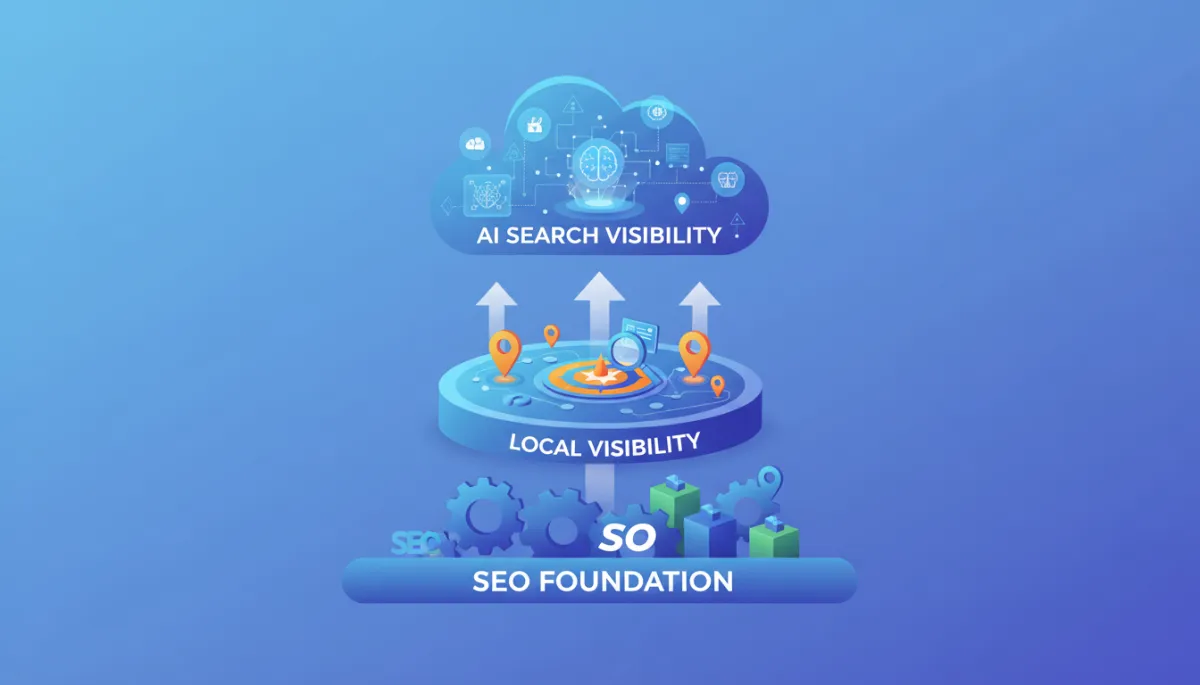
Layer 1: SEO Foundation — Website health, technical SEO, service pages, content, and authority.
Layer 2: Local Visibility — Google Business Profile, reviews, maps, local pages, and service areas.
Layer 3: AI Search Visibility — Direct answers, original insights, structured information, evidence, and clear authorship.
Each layer supports the next. AI search visibility is strongest when the website and local-search foundations are already in place.
A technically weak website, thin content, or unclear business information gives search and AI-assisted systems less reliable material to retrieve and reference. Structured data can support understanding, but it cannot compensate for a weak foundation.
Connecting Search Visibility to Measurable Outcomes
Search visibility becomes more valuable when inquiries can be connected to conversations, appointments, customers, and revenue. Once the required integrations and tracking are configured, CRM and attribution platforms such as LeadMagno can help businesses track identifiable, search-driven inquiries throughout the customer journey.
In practice, this may include connecting website form submissions and other identifiable inquiries with follow-up conversations, appointments, opportunities, and recorded revenue outcomes. While no platform can identify every organic-search visitor or every AI-assisted interaction, these connections can help you understand which channels and content appear to support real business results. Bing Webmaster Tools’ AI Performance report can also help businesses monitor citations, referenced pages, and visibility within supported AI experiences.
Hypothetical example (Ontario dental clinic): A local dental clinic in Ontario could use LeadMagno to see that a portion of its new patient consultations started with organic search, moved through a website form, and were then nurtured by automated reminders until a booking was confirmed. In this scenario, the clinic can more confidently invest in the channels and content that appear to support those outcomes.
Frequently Asked Questions
What is the difference between SEO and Local SEO?
Traditional SEO focuses on improving your website’s overall visibility in organic search results, often across wider regions or countries. Local SEO focuses on helping nearby customers find you through local results, map listings, and location-aware searches that can lead to calls, directions, and in-person or localized appointments.
What does AI search optimization mean?
AI search optimization is an industry term for practices that make your content clearer, more structured, and more helpful so that AI-assisted search tools can better understand, summarize, and reference it. It builds on traditional SEO rather than replacing it, and is closely related to concepts like Answer Engine Optimization (AEO) and Generative Engine Optimization (GEO).
Does AI search optimization replace traditional SEO?
No. AI search optimization does not replace traditional SEO. Google continues to emphasize that core SEO fundamentals — such as useful content, good user experience, and technical soundness — remain important, including for AI-assisted search features.
Does structured data guarantee AI citations?
No. Structured data can help search engines and AI systems better understand your content, but it does not guarantee rankings, map placement, or citations in AI-assisted results. It should be viewed as a supportive practice rather than a promise of specific outcomes. For more information, see Google’s general structured-data guidelines.
Which approach should a small business prioritize?
Many Canadian small businesses benefit from a balanced mix: Local SEO to reach nearby customers, traditional SEO to build broader visibility and authority, and AI search optimization to ensure their best information is easy for modern search and AI tools to interpret. The right priority depends on your market, services, and capacity, so it helps to review your situation before committing resources.
The Bottom Line
Traditional SEO, Local SEO, and AI search optimization are not competing services. They solve different parts of the same visibility problem.
Traditional SEO provides a strong foundation for your website. Local SEO connects your business with nearby customers. AI search optimization makes your expertise easier to understand, summarize, and reference.
Most businesses need all three, but not always at the same time or with the same level of investment. Start with the area that most directly affects how your customers discover, evaluate, and contact your business.
Build a Search Strategy Around How Customers Discover Your Business
An Organic Growth Audit can help identify whether your most important opportunity is traditional SEO, Local SEO, content improvement, website performance, or AI search readiness.


